
Scotland in the 1800s
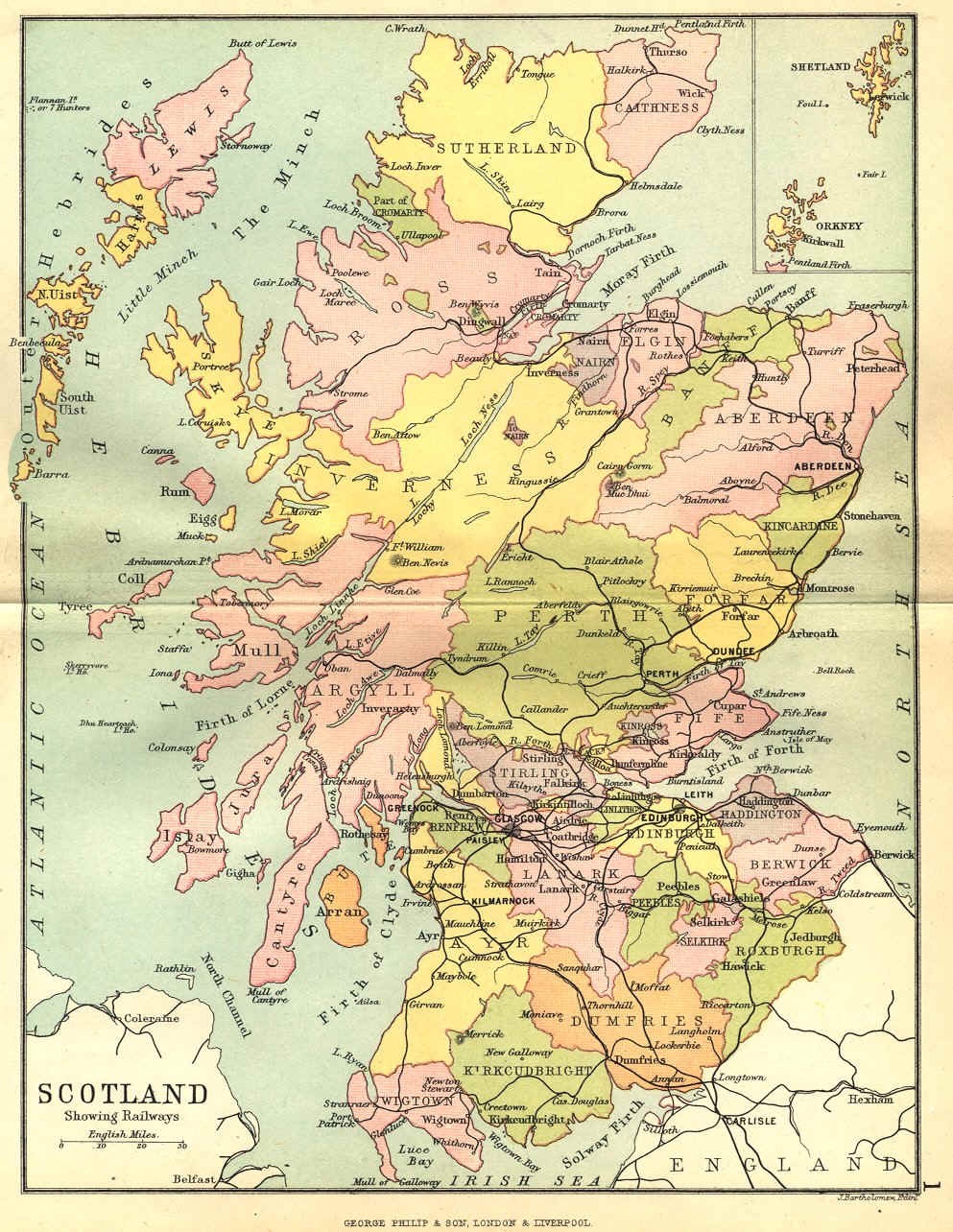
Our Scottish heritage originates with a large family of Rosses from Ross-shire (seems like a good many people living in Ross-shire were named Ross!), some of whom came to Australia in the 1850s and 60s. There are many descendants of this family still living in the UK, others have migrated to Canada, and it is likely that there are others of whom I have no knowledge spread around other parts of the world. We are in contact with only a few, and none of them, including us, now bears the name Ross. The short account that follows recounts some of the story of the eldest daughter Ann Ross, born in 1824, the second of the Ross children. Subsequent articles will relate what I know of some of the others.
The patriarch, James Ross, with whom all these stories begins, was born in Edderton between Ardgay and Tain on the southern side of Dornoch Firth probably around 1795, though the exact date eludes me. On the northern side of Dornoch Firth is the old shire of Sutherland. James married Catherine Urquhart, who grew up in Golspie, a town further north on the Sutherland coast. How they met remains a mystery to me, but once married they settled in Gledfield, a village near Ardgay, where they raised their large family.

A Scottish holiday
Last summer (2023) Maria and I had a brief holiday in Scotland. We stayed in an old house in Cromarty, a little town on the tip of the so called Black Isle, a peninsula jutting out from the east coast just north of Inverness.
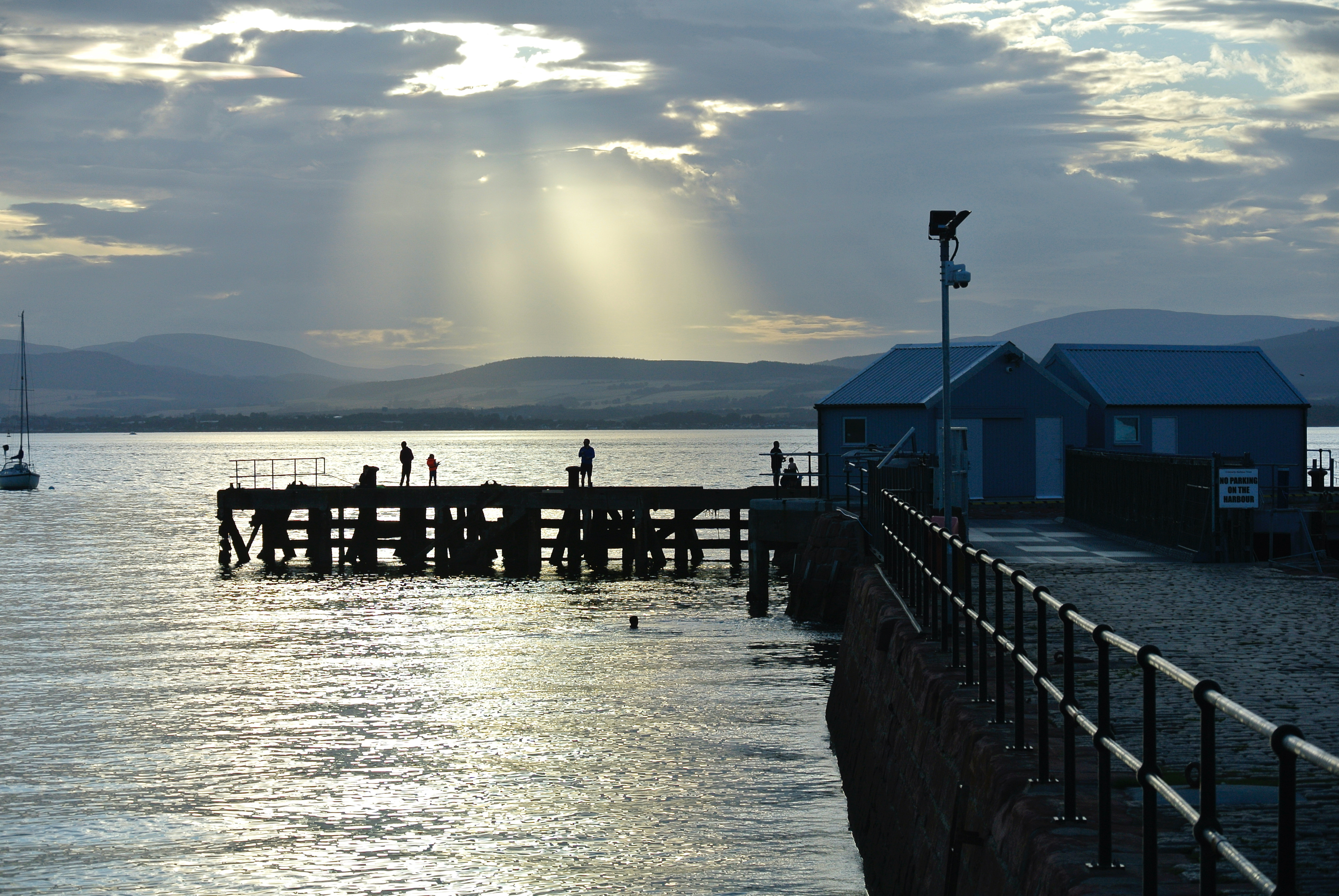
We travelled one day up to Edderton, where we had coffee with Diana, who is married to David (who wasn’t home), a descendant of one of the Ross family who remained in Scotland, but whose grandchildren ended up in England. For many years Diana and David had a home near Nigg, just across the firth from Cromarty, and about 10 miles south of Edderton. They have recently moved to an old house in Edderton so, two hundred and thirty years after James Ross was born there, they have returned to David’s ancestral roots.
David is descended from Ann Ross, who was the second of James and Catherine’s thirteen children. Ann was, as far as I know, the first of the Ross children to marry, in 1849 when she was 25. Ann married a man a few years younger than her, Hugh Aird, who like her father was a blacksmith from Edderton, which is where Ann and Hugh made their home after they married. They had three children, but tragically Hugh died of appendicitis when he was just 28, 6 years after their marriage. Ann moved with her three little children back to her parents’ home in Gledfield, but never remarried. Her children grew up in the same valley as she had herself – the Strathcarron.
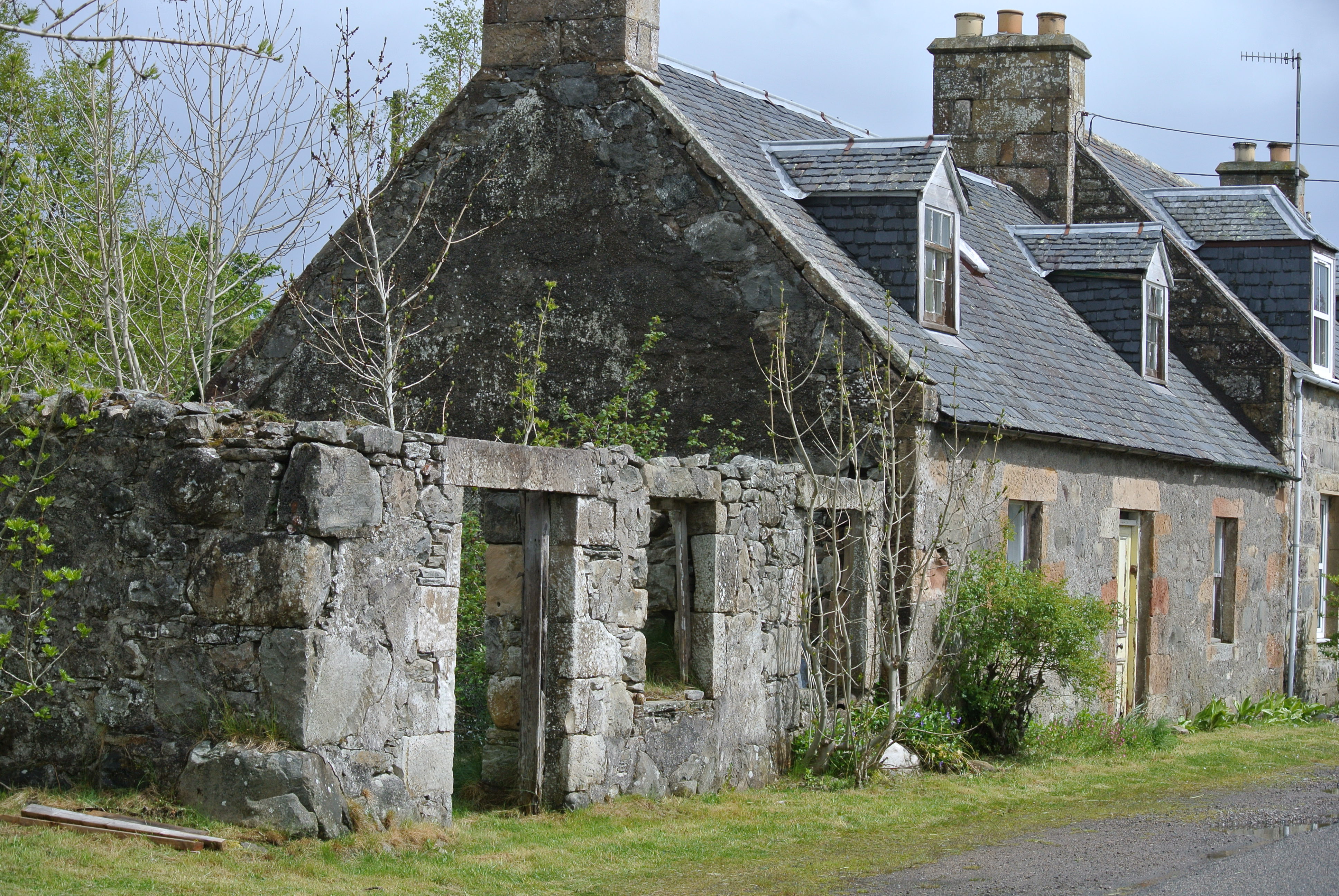
Her son Donald, the middle of the three children, when he left home, moved back to Edderton, and lived there his whole life. Ann eventually went to live with Donald, who by that time was married and raising a family of his own. She remained there until she died.
Donald Aird (1850-1941)
Donald was only 4 when his father died. Back in Edderton, as an adult, he became a general merchant, with his own store. As such he was well known in the little community. At the time of his death in 1941 an obituary appeared in the local paper which provides a sketch of his life:
Mr Donald Aird, who passed away at his residence, Quattro Bras, Edderton, on Tuesday September 23, 1941, was the oldest inhabitant of the district. The son of the late Mr Hugh Aird, blacksmith, Balloan, Edderton, [he was] born in 1850; the deceased was thus 91 years of age. He spent all of his long life in the district. It was a life of much usefulness, public, social and religious. Taking a keen interest in public administration, he served both on the School Board and the Parish Council and was chairman of both bodies., and an ex officious JP. Otherwise he placed the social welfare of the district in the first place and was the friend and counsel of young and old alike, and always in a quiet, unostentatious way; he had a ceaseless flow of the milk of human kindness. Staunch Churchman, he was successively elder of the Free Church and the United Free Church, which by evolutionary processes, in the spirit of unity, brought members of both of these bodies back into the fold of the Church of Scotland of which latter, to the end Mr Aird was an elder. It is recalled that Mr Aird was a preceptor in these bodies for over half a century and in 1910 his services in that and other capacities, including superintendent of the Sabbath School, were tangibly recognised.
Mr Aird carried on business as a general merchant in Edderton for 60 years, retiring in 1932. In 1883 he married Johan (pronounced Shan) Munro, daughter of the late David Munro, Rhanich, with whom he had four sons and five daughters by whom he is survived. To his lifelong partner and members of the family, sincere sympathy is expressed by a wide circle of friends. The surviving members of the family are David and Katherine in the United States; Malcolm in Canada; Lizzie (Mrs Ross, a widow), Edinburgh; Hector, in London; Hughina, teacher in Keith HG Public School and Alistair, Annie and Johan at home…
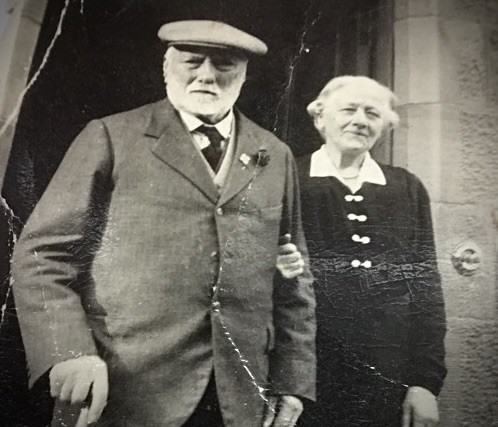
Donald and Johan (Shan) had ten children. Of these, two of them – Cath and David – migrated to America, but returned to Scotland late in life. Cath was a spinster, David married but had no children and he came back in retirement when his wife died. Another of the children, Malcolm, migrated to Canada, where he married and made a life. Hector, the second youngest, remained in London after WW1 – more of him below. The others all remained in Scotland, three of them in Edderton. They ran the family business in the 30s, 40s and 50s.
Donald, their father, as the obituary above explains, “carried on business as a general merchant in Edderton for 60 years, retiring in 1932.” He and his wife operated the “Edderton Stores,” and were therefore well known in Edderton. After he retired Annie and Johan (also called Shan, like her mother), who were both unmarried, continued the business, together with Alistair, the youngest son.
Childhood visits to Edderton
Hector (in London) had two children, Mary and Donald, the English Rosses. Mary is now in her 90s and she and I carry on a regular correspondence. Recently widowed she now lives in a retirement home in Surrey, south of London; her husband Edward was a clergyman in the Church of England, and they lived until his passing a few years ago in a house called Woodsyre, where I first met them, around forty years ago. One of their four children is David, mentioned at the start of this article. I knew nothing about my Scottish heritage when we first met, but over the years Mary has shared many memories with me, and some of those revolve around Edderton. She wrote this about her father’s family in Edderton and her visits there as a child:
My father Hector Alan Ross joined the Seaforth Highlanders in WW1. He was working in a bank in Tain and aged 17 he volunteered claiming to be older and was accepted. He never spoke about his time in France and somehow we never felt it right to ask him. We know he suffered trench foot fever and was sent home to a military hospital. He had foot problems for the rest of his life but was lucky to survive as the Seaforths had heavy losses. He had a silver cigarette case in his breast pocket and that probably saved his life as it was badly damaged by a bullet.
My aunts (Hector’s sisters), like many of their generation, were unmarried – perhaps because the men they might have married were lost in the war. After the war my father stayed in London and joined the Civil Service where he met my mother. He also joined the London Scottish Territorials. My parents married in 1927. They had just my brother and me. I do not remember knowing there was to be a new baby but I do remember being taken into my parents bedroom, sitting in a chair by the fire and a nurse saying ‘this is your baby brother’ as she put Donald into my arms. We were always close and before our marriages we used to go to Edderton together to stay with the kind aunts. We loved helping in the shop, going with the driver who delivered weekly orders to the scattered crofts in the hills, and exploring on bicycles.
We went Euston to Inverness by overnight train, sitting up in a carriage, as when young we could not afford a sleeper. Arriving in Inverness we went for a snack then caught the slow train north that stopped at every little town on the line. As we drew nearer to Edderton we became excited – at last Tain – nearly there! Arriving at Edderton station we were met by the shop van, put our luggage in it and started the less than a mile walk to the shop along the then unsurfaced road. During the worst of the Flying Bomb attacks, for which there was no warning, my mother, Donald and I went and stayed with the aunts…
Edderton Stores
The old shop owned by Donald, then his daughters, still exists, though it has not belonged to the Airds since the 1950s. A few years ago Mary’s son David sent me a photo of the way it looked then (2018). The next picture is a photo taken in the 1970s or 80s by another Ross descendant (Don Robinson) who was visiting at the time . The last is from 1915 or 1916.
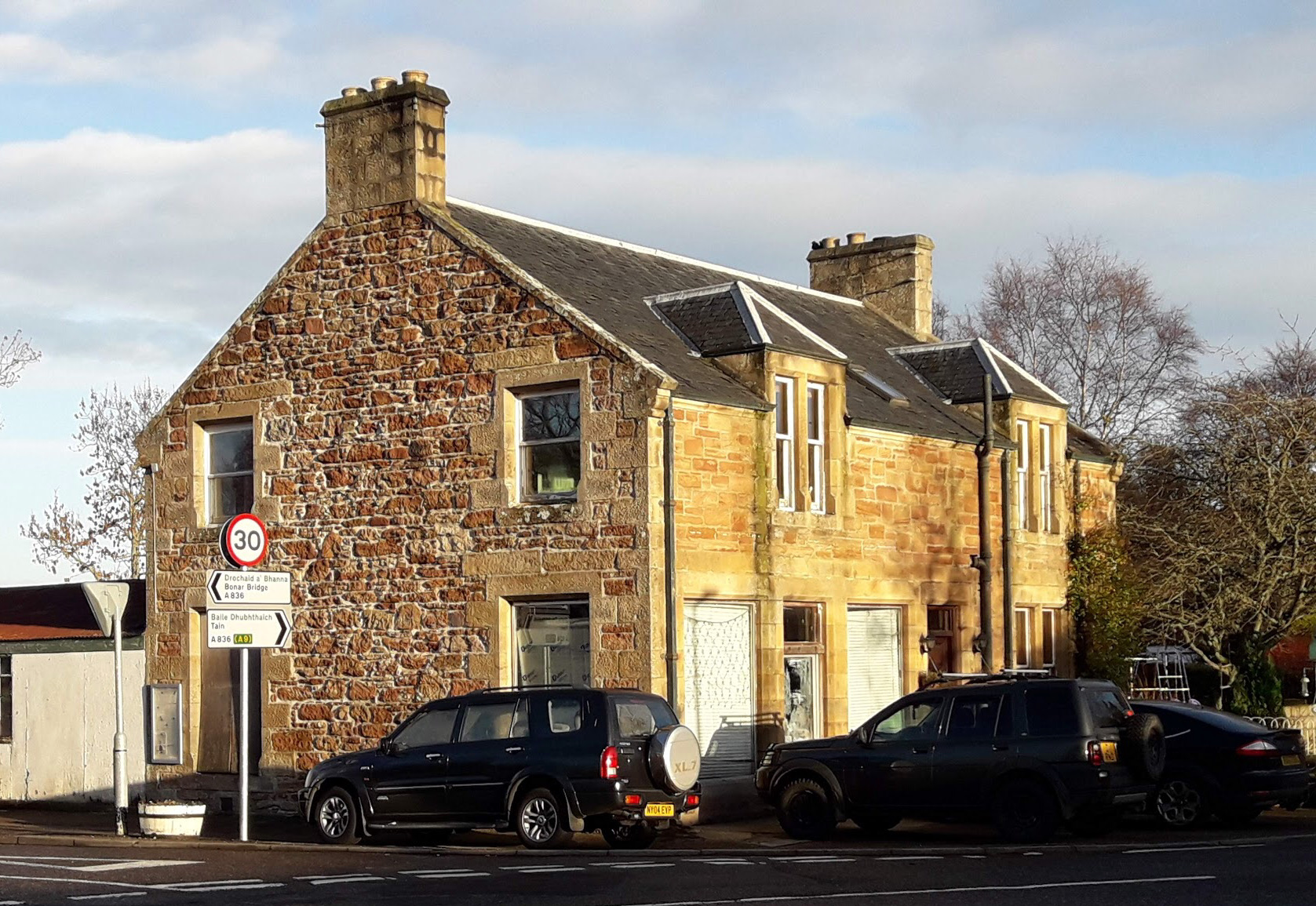
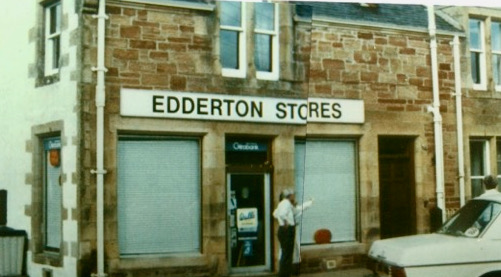
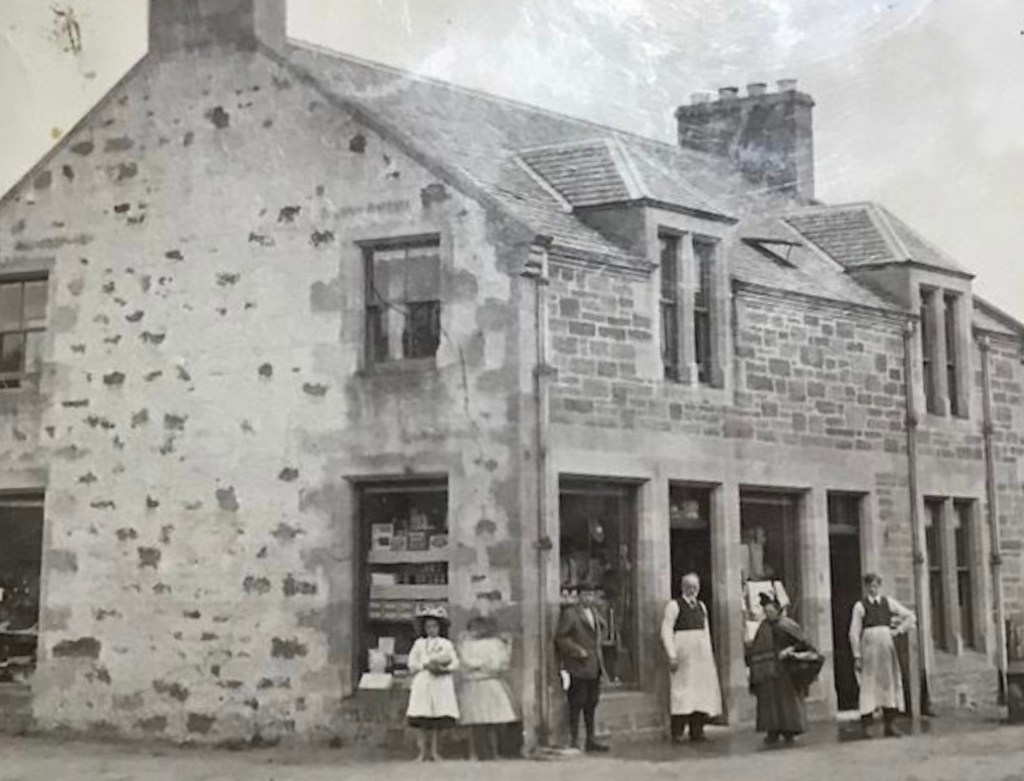
After Donald retired in 1932 the shop was taken over Annie and Johan (“Shan”), the “kind aunts” who welcomed Mary, her brother and their mother as refugees during the flying bomb attacks on London during WW2. Grandfather Donald died in 1941, survived by his wife Shan. Their home, until Shan passed, was in the right side of the same building. According to Mary:
It was the Ross blacksmith uncles who bought the land and paid for the shop and a pair of houses to be built further along the road. They lived in a big house at Ardgay. [My] aunt Shan was actually named Johan (like her mother) but as a child my father called her Shan and it stuck.
Who then, were these Ross blacksmith uncles? James Ross, who I have mentioned, was the patriarch of this story, born in Edderton in 1795 or thereabout, but lived all his adult life in Gledfield, where he was the village blacksmith. His first daughter was Ann, who was Donald Aird’s mother. At least three, perhaps four of his sons became blacksmiths. The youngest was Hector Ross, who never married and remained in Gledfield/Ardgay all his life. He died in 1921 in Edderton. He is presumably one of the “Ross blacksmith uncles” that Mary mentions, and he was Ann Ross’s youngest brother. John, Andrew, and Malcolm Ross were all blacksmiths, at least for a time. John and Andrew both died young, John in England, Andrew in Australia. Malcolm married and became a farmer. Two other sons, Donald and George, were probably also blacksmiths, but I have no idea what became of them. The “Ross blacksmith uncles” who owned the house in Ardgay were presumably Hector Ross plus one or more of the others.
Mary explained the following about the shop in a recent email:
Annie did the ordering and Shan served in the shop and was popular with customers. At busy times she employed a young woman from the village. There was also gruff rather stern Jock Mackay who kept the shop clean and tidy, did some gardening and any jobs eg dealing with the salt herring barrel and bottles of lemonade that were very popular and in different varieties eg cherry, lime, orange.. Jock lived with his widowed mother at Ardvannie but to the surprise of all he suddenly announced he was marrying Bessie from Edinburgh whose father was head gardener of Princes St Gardens. They had a long, happy marriage and retired to a Council house in Tain...
When the shop was eventually sold, in the 1950s, the aunts, Annie and Shan, moved to a house they bought outside Tain, a neighbouring town. Hughina, who lived in Keith, would come and visit in the holidays. Eventually David, when his wife died, came back from the USA as did their sister, Catherine. Johan died in 1962, Annie in 1972, David in 1982 and Cath in 1986. I am not certain what became of the youngest of the Aird siblings, Alistair.
With David and Diana moving to Edderton, this particular Ross-Aird branch has come “home.”
Castles and Clearances
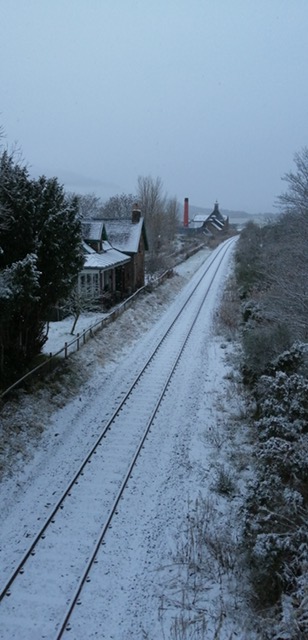
The railway line from Inverness passes behind David and Diana’s house, between the village and Dornoch Firth. Beyond the firth, on the northern horizon atop a distant line of hills, I spotted in the distance the huge statue of the Duke of Sutherland, a man who liked to think of himself as “The Great Improver,” but is remembered by many as “the great destroyer.”
The Duke, who was English, came into possession of the huge estate in Sutherland through his wife, who inherited the land and the castle that stands on its edge. Dunrobin castle is an ancient edifice that was massively renovated in the eighteenth century at great expense, which was the Sutherlands’ Scottish “seat.” Now, of course, it is a tourist destination. After our morning coffee with Diana, Maria and I drove up to visit. As extraordinary as the castle might be, the place is touched with a blend of sadness and anger for me, knowing the history of the place and its owners, who cleared much of their land of the tenants that had lived their for many generations to make way for more profitable land uses, namely sheep grazing. These people, thousands of them, were simply forced to leave, and then their houses were burned to prevent them returning. It was the end of a Highland way of life. It enriched the Sutherlands, and many other landowners like them, but plunged thousands of their tenants into poverty. Some found homes and rebuilt their lives in the coastal towns and villages, but many were forced to move to the Lowlands, to England, or to the rest of the world.
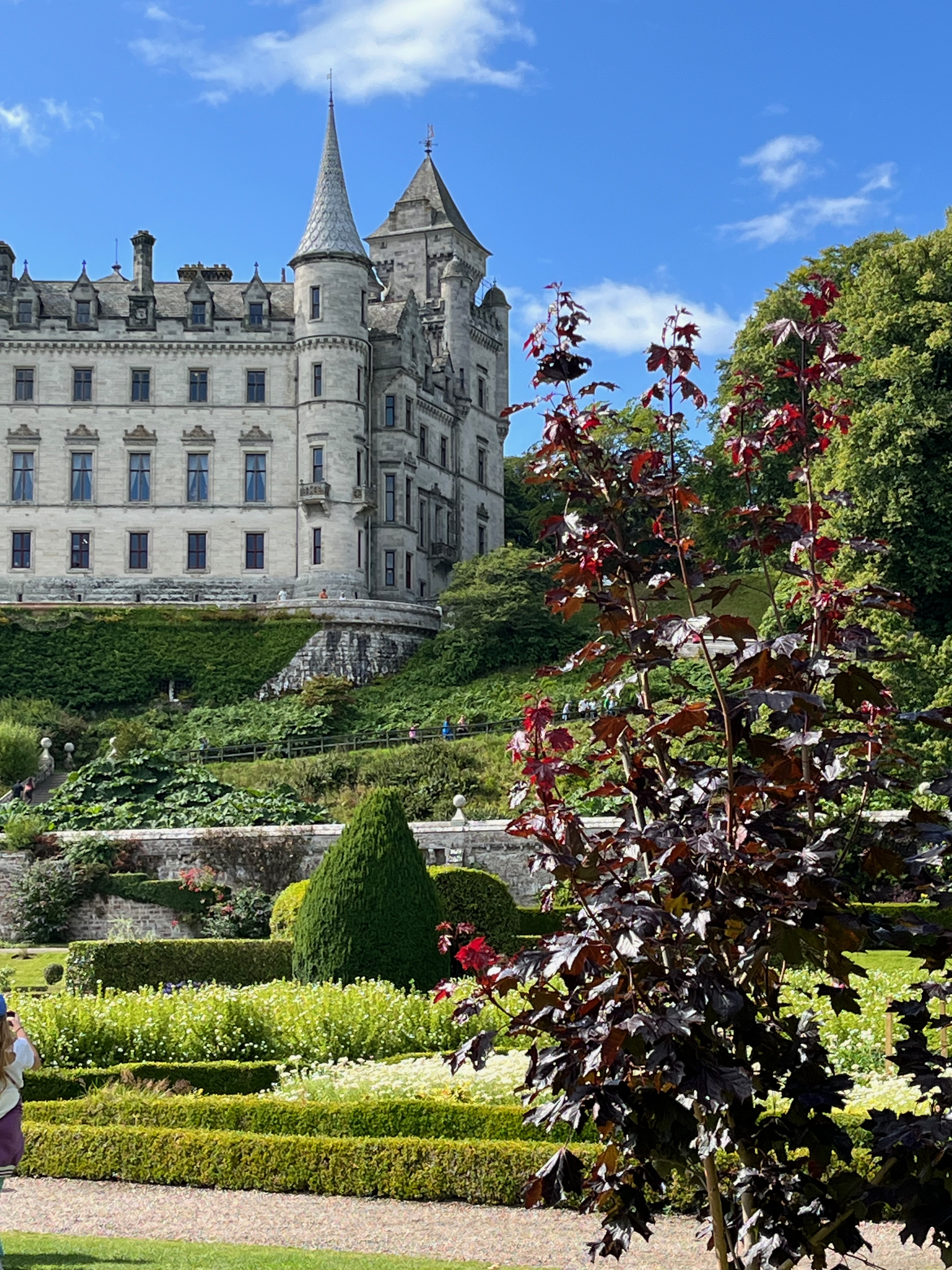
The castle stands just outside the coastal town of Golspie, where Catherine Urquhart, James Ross’s future wife, was born and spent her childhood years. She would have been painfully aware of the clearing of the mountain glens in the first few decades of the 1800s. Over the first twenty years of her life the Sutherlands forcibly removed up to 10,000 people to make way for sheep, of which I have written elsewhere.
Sadly Catherine and her husband James would witness more brutal removals later in life too – in the valley that became their new home – the Strathcarron. Sally Magnusson’s recent novel – Music in the Dark – vividly evokes the trauma and sadness of the Strathcarron Clearances. Rosses and Airds feature prominently in her story.
How did James and Catherine explain such injustice and cruelty to their thirteen children who witnessed the departure of the Highland people for distant lands? Though the Rosses were never evicted, living as they did in a village, owning their own home and business, many of those children would leave the Highlands, and even Scotland. Mary’s great grandmother Ann chose to stay, as did her children, but Hector, Mary’s father, ended up in London. One of Ann’s younger brothers, James, who was my great great grandfather, was one of those who left, first for England and later for Australia. But that is another story.
 Forgotten tales
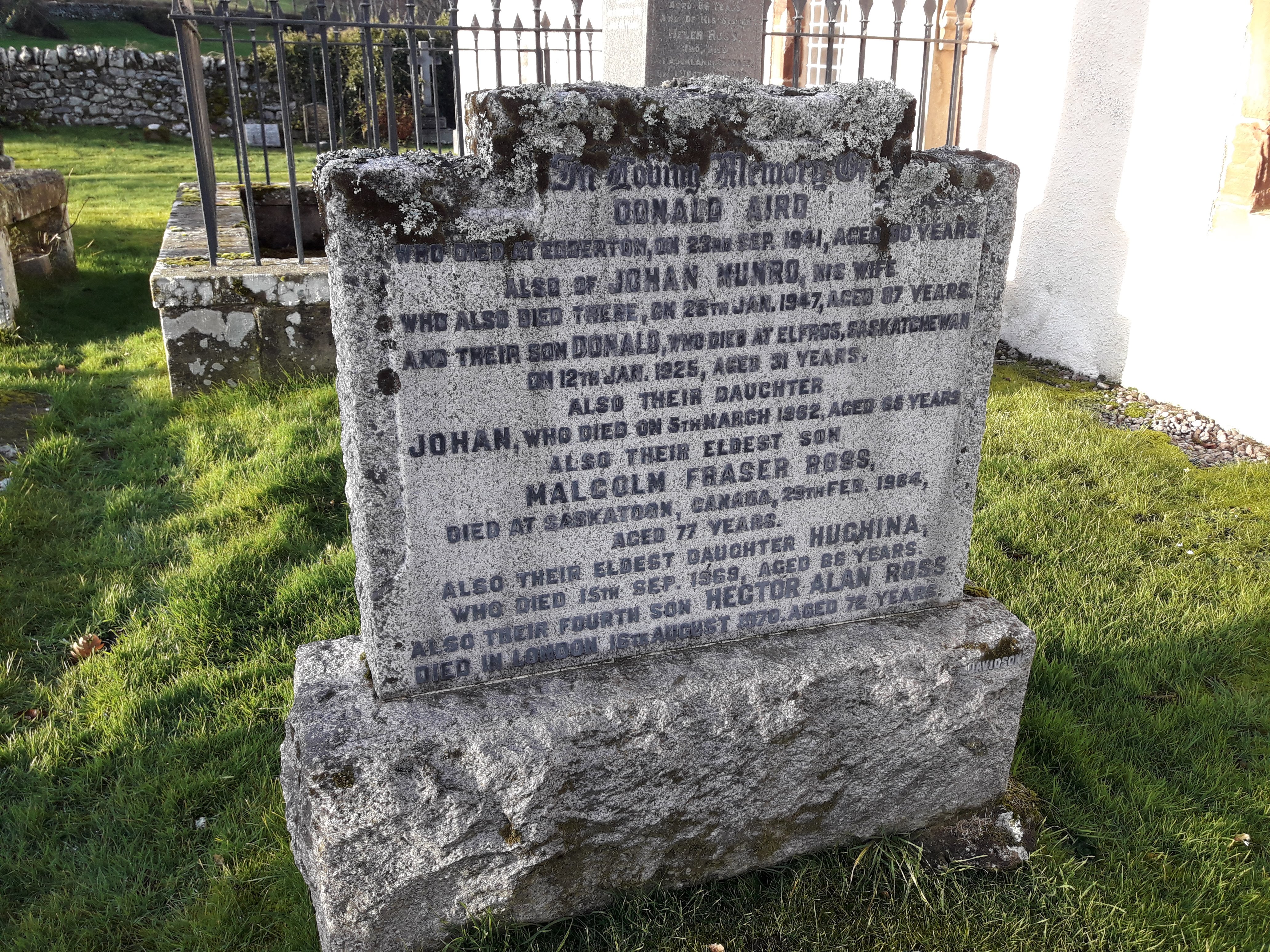
I live in NZ and my great grandad is buried in the Hanmer Springs cemetary, Donald Ross, he was from Eddington Scotland,also a Donald Ross from there who was killed by lightning at 27 years. My Mum always told me they were my relatives,I don`t live there now but go back often,hope this is helpful,Denise Bailey.
might be the same family, might not. Seems there are lots of people named Ross in Ross shire, and there lots of Donalds in Scotland. The oldest Ross in my family was Donald I think born 1823, and I am not sure what happened to him. Did he go to NZ?
they are definetly spelt wrong! I would have to look at the headstones next time in Hanmer, it is winter here so won`t be down there for afew months. I have been to the Edderton cemetary,about 20years ago,I took a bunch of flowers,,it was full of Rosses and McKays,who are also buried at Hanmer, so Ieft the posy at pot luck! Please keep in touch,are you Scottish? cheers, from NZ. just thinking could they have came here after the clearances?
Hi again, if you have a look at this family outline at https://holfiesfamilyhistory.blog/families/james-and-catherine-ross-m-1822/ you will see the children of my Ross family. You will notice that the oldest child of the family, born 1823, was Donald Ross, and that I have no information on him. I have often wondered what became of him. I live in Australia, as you will see if you read some of my other Ross blogs. Check out the Ross tag on my forgotten tales blog. My great great grandfather was James Ross who came with his wife and children to Australia in 1866. Three of his siblings came too. James’ family mostly stayed no Sydney, but his siblings all went north to the country around Coffs Harbour. A younger brother, James, had a son named Donald. But I have almost no contact with any of those Ross descendants. James’s older sister, Ann Ross, married an Aird from Edderton and remains in that area though her husband died young. This Edderton blog is about their son Donald Aird, and his descendants. I have regular contact with Donald Aird’s granddaughter, who is in her 90s and lives near London. Have fun trying to work out when your Donald came to NZ!!! May well have been around the time of the clearances (which happened sporadically over many years)
What a detailed and interesting article! Greatly enjoyed reading it. I have been connected with Edderton for 30 years thru a friend who farms on the hill above. Love the picture of the store.
Thanks for the comment. It’s wonderful to connect with people of the present through the stories of the past. Edderton and the country around it is such a special place. Mary Thompson (Ross), whose family story is the theme of this article, passed away recently and her ashes were interred in the Edderton churchyard. It was a moving occasion. She was the source of much of the information I gathered for this article.