North of Inverness on the east coast of Scotland there are three deep inlets from the North Sea: the Moray Firth, the Cromarty Firth and the Dornoch Firth. Between the Moray and Cromarty firths is the so called Black Isle and between the Cromarty and Dornoch firths is another land mass which is rather hilly, almost mountainous on the inland side. Driving north from Inverness nowadays there are long bridges crossing each of these firths but in the old days before they were built travellers heading north had to make their way inland to where the waterways were narrow enough to cross, adding many miles to the journey. The towns which grew up at the various crossing points were much more important in those days than they are now and in some cases they have shrunk considerably. At the head of the Moray Firth is Beauly (the higher reaches of the Moray Firth are called the Beauly Firth), while at the head of the Cromarty Firth is Dingwall, though the water is crossed even further up at Conon Bridge (over the Conon River). Beside the headwaters of Dornoch Firth is the village of Kincardine, near Bonar Bridge where the Kyle of Sutherland (which flows into Dornoch Firth) is crossed. But these are bypassed now by the bridge that crosses the firth from near Tain to near Dornoch.

The Ross family from which I am descended lived in Gledfield, which is near Kincardine. Between Kincardine and Gledfield these days there is a village called Ardgay, which isn’t even marked on maps from the early 1800s, and which is now bigger than either of the two older villages. Ardgay is about halfway between Bonar Bridge and Kincardine and there is a railway station there, which may be the reason it has grown so much. The Highland railway didn’t reach the area until 1864, so it did not feature in the early life of James Urquhart Ross, who migrated to Australia in 1866, following his younger brother Andrew and sister Helen. Bonar Bridge, on the other hand, was built in 1819, and would have been the main crossing of the Kyle of Sutherland-Dornoch Firth waterway.
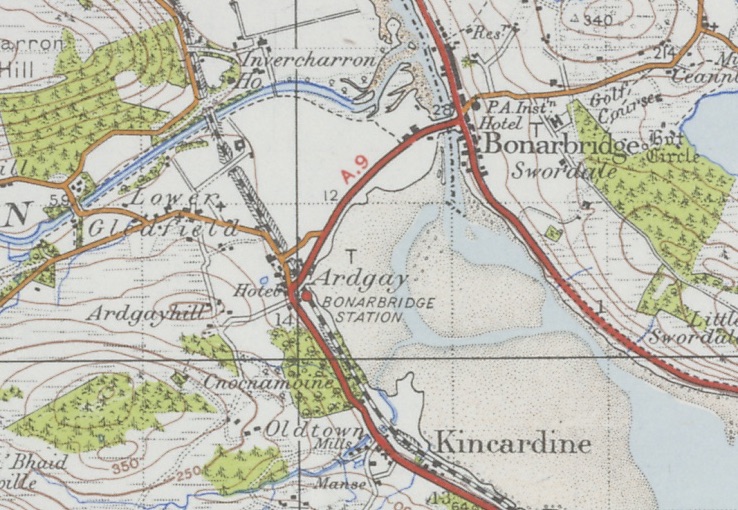
In the middle of Ardgay a smaller road branches off and heads inland up the valley of the Carron River. The houses end, giving way to fields, but only a few hundred metres further on there is another scattering of houses. This was once the village of Gledfield, but there is no sign to say so, and on current maps it appears as Lower Gledfield. The village today is just a few lines of houses on either side of the road.

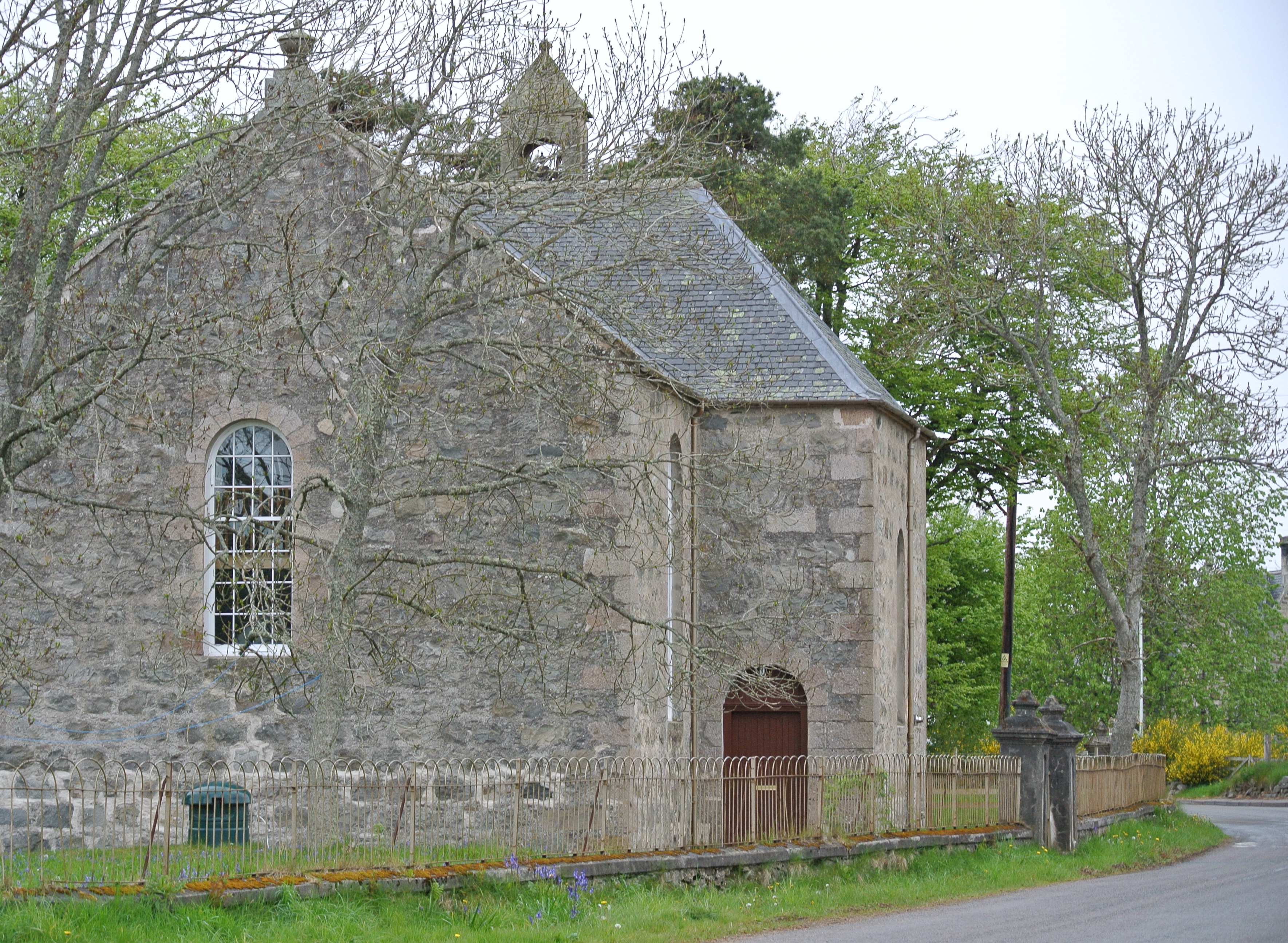
Entering Gledfield village from Ardgay, the first building on the right is the Church of Scotland, set back from the road along a dirt track, on a slight rise. A little further along the road, on the right, is Gledfield Public School, and still further along on the left is another church, without a sign, which on closer inspection appears to have been converted into some kind of residential dwelling. It is the old Gledfield Free Church. Just past the church there is a fork in the road. The right fork leads across farmland to the Carron River bridge, an arched stone structure. Across the bridge the road divides again, either heading north to Culrain and the Gledfield Estate, or west along the northern side of the Strathcarron. The left fork in Gledfield village heads westward along the southern side of the Carron River, climbing gradually into the hills.

At the fork in the road, on the right and almost at the end of Gledfield village, there is a ruined roofless building built onto the end of an old, derelict house. Built onto the other end of the house, closest to the village, is a newer dwelling which looks lived in, though there was no-one around the day we were there. All three of the buildings are of grey stone. The roofless ruin is the old blacksmith’s shop and the derelict house, I presume, was once the home of the Ross family of Gledfield. It was here that James and Catherine lived and raised their twelve children between the 1820s when they married and the 1860s when James died. James Ross was the Gledfield blacksmith, and several of his sons followed in the same trade. James Ross junior, my ancestor, was the exception to this rule, becoming a journeyman joiner.
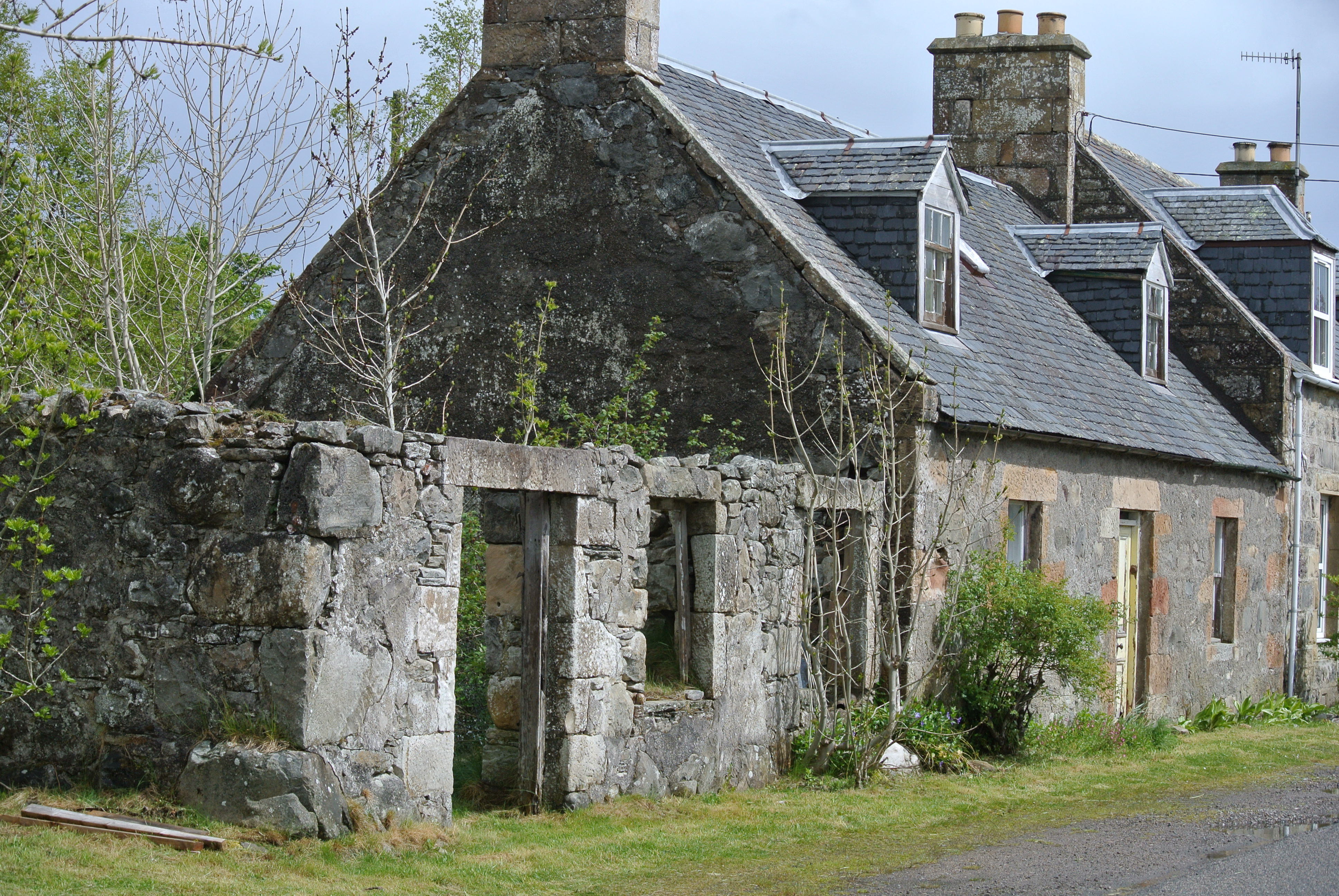
Although the Ross family lived in the blacksmith’s house at least until James Ross senior died in 1866, records indicate that his wife Catherine moved after his death. The 1871 census indicates that she lived with her unmarried sons Malcolm and Hector at Upper Gledfield, though exactly where Upper Gledfield was I have not been able to work out. By 1881 Catherine’s address is Gledfield Free Church, still with Malcolm and Hector, though by then Malcolm had married Jane Munro. Malcolm and Jane appear never to have had children. Malcolm is listed as Master Blacksmith And Farmer (Of 11 Acres, All Arable, Employing 2 Man 1 Girl). He died in 1897, 57 years old. Malcolm’s younger brother Hector lived with them. Hector never married and was the last of the Ross children to die, in 1921.
 Forgotten tales
I lived in Gledfield 25 years where my father H.J.Whistler was employed as Chauffeur /companion to E.M.Bainbridge 1932 & then Capt Minette-Lucas, In Kincardine cemetry in a crypt (unable to remember family name) I found Gledfield was previously GLADFIELD, who sold Gledfield to Bainbridge ? Jill D.Carr
Interesting, thanks for the info. I have seen that the village is called Gladfield on old maps and records. You say you lived there for 25 years. How long ago was that?
I am nearing my 90th birthday .I moved to Gledfield in 1933 aged 11 months and lived there till 1956
Hi Jill. You moved to Gledfield the year my father was born. My father’s great grandfather was James Ross, born in Gledfield in 1827. He left Scotland around 1850 and moved south to England where he married a Welsh girl. They left England with their first three children around 1866 and migrated to Australia, where they had a number of other children. Dad’s grandfather was about 5 when he left England. He married a girl of Irish parents and had five daughters one of whom was my father’s mother, my grandmother. My father was born in 1933. The only other branch of the Ross family of Gledfield with which I have contact are descended from Hugh and Ann Aird. Ann was the older sister of James Ross, my ancestor. A descendant of hers is Mary Thompson, aged 90, who lives in London. She writes to me often. One of her sons owns a holiday house in the Edderton area, and I suspect feels a strong sense of connection to the area. I really do look forward to the day when I can get back there for a visit.
Did you ever know someone called Isabella Agnes Anderson ? Lived in Ardgay
No, sorry I don’t know any Anderson’s from Ardgay. Tow of my Ross ancestors from Gledfield married Andersons in Australia, but neither of them came from Ardgay as far as I know. Hope you find her.
I am also trying to locate Upper Gledfield because my 2x great uncle lived there as a lodger in 1871. He went on to become Chief Constable of Ross and Cromarty but in 1871 was a lowly constable! Thanks for the interesting insight.
Hi Sue, Had a quick look at your blog and website. Looks like you’re retired which sounds very sensible. More time for family history research. So you had an ancestor who lived in Gledfield? A little place, but very beautiful. Bit more barren than the Cotswolds! My great great grandfather was born and bred there but left in the 1840s. His youngest sister Jane left in the 1860s. Four of the family migrated to Australia. The others all stayed in Scotland or England. The two youngest brothers Malcolm (b.1840) and Hector (b.1843) lived there most of their lives and are both buried in the graveyard of the church at nearby Kincardine. Their oldest sister, Anne (b.1824) lived in Edderton. Anne’s granddaughter, Mary, passed away just a few weeks ago, having lived most of her life in London. During the war Mary (as a child) was a regular visitor to Edderton. She was in her 90s when she died. I saw her two years ago when I was last in the UK, and she was as bright and talkative as ever. Her son and daughter-in-law have a house in Edderton, though they live in the South. Anyway, if you want to find Gledfield it is close to Ardgay and Bonar Bridge in Ross-Shire (now part of “Highlands.” You should visit sometime.