
Why leave?
In Kay Caball’s latest blog on her Kerry ancestry and genealogy website (mykerryancestors.com) she asks the question: “Why did your ancestors emigrate?” Her answer?
To get work is the immediate answer. Opportunities for education, particularly in the first half of the century, were very limited, especially if you lived outside the main towns, and while education was highly prized, it was not always possible for all the children in large families to avail of it. There was no employment for the vast majority, no land available to acquire and absolutely no ‘opportunities’ as they are now called.
Kay Caball, Life in Kerry in the 19th century, January 2020
The question of why our Kerry ancestors migrated has often occupied my thoughts. My conclusion is that they left because they were Protestants in a predominantly Catholic county, and they were “Anglo-Irish” in a country where there was growing antagonism toward the English. For both reasons I believe they had begun to experience a growing feeling of rejection by the “native” Irish. In short, although their ancestors had called Kerry home for generations, in some cases even centuries, they increasingly felt like unwanted outsiders.
My Kerry ancestors were Hicksons, Needhams, Byrnes and Ruddles. The Hicksons had come over from England in the Elizabethan plantations, and some, at least, of them were Anglo-Irish “gentry,” who were increasingly seen as being identified with the enemy. The original Kerry Needham was in the British army, and George Needham (1801-1863), though he was born and died in Ireland, was in the Kerry Coastguard, both institutions that were resented by many. The Ruddle family probably had English origins too, though they may have been descended from Ruttles, who were originally Palatines, immigrants from Germany in the 1700s. Only the Byrnes had a “real” Irish surname, but as far back as I have been able to definitely trace, which is only the mid 1800s, our Byrne family were Protestants, so they too may have felt antagonism from the largely Catholic population, leading to a feeling of being “outside.”
It’s hard, of course, to know what any of our ancestors felt, whether they actually felt “outside,” and even if they did, whether it bothered them. It’s hard to know how important religion was to them, or an Anglo-Irish identity for that matter. Was their allegiance to the “establishment church” – the Church of Ireland – simply a nominal thing, inherited or pragmatic, or was it deeper than that, theological, political, relational or spiritual? Did our Anglo-Irish ancestors feel English, or Irish? What does that even mean?
Having said that, I believe that for the Needhams and the Byrnes at least, religion was very important. A revival in the Protestant population of Kerry in 1861 had a profound effect on all of these families, and many of them left the Church of Ireland to join the so called Brethren movement. Four Needhams became pastor/evangelists in North America, and the Byrnes remained staunch Brethren after their arrival in Australia for at least the next generation.
As to their Anglo-Irish identity, one of the Hicksons, John Christopher, was clearly a royalist, at a time when many Irish wanted nothing to do with the English royal family. Later in life he made the not inconsiderable journey from Sydney to London for the coronation of King George V in May 1911. He also made a big thing of his connections with the Anglo-Irish gentry, naming his home in Sydney The Grove, after the “ancestral seat” in Dingle (though exactly what his connection to the Hicksons of The Grove was is thus far unclear to me).
As for Kay’s suggestion that it was for education and employment that our ancestors left, it would seem that the Byrnes, the Hicksons, the Ruddles and the Needhams were better off than many others, in the years after the Famine, perhaps because of their Anglo-Irish and Protestant connections. But the fact remains that families were large and the opportunity for employment or advancement in a place like Kerry was very limited, even with a basic education. Stories of opportunity (not to mention gold) in America and Australia abounded and would have been hard to resist. Then as now people were concerned for the future survival of both themselves and their children.
Go where?
Kay’s second question with regard to emigration is, “Who paid the passage and why did they decide on particular locations?” Her response?
This is probably one and the same question. Single people emigrating got the fare from relatives already in the emigrant country, which would be paid back after arrival and employment. This ‘passage money’ would then be re-cycled on to the next brother or sister whose turn would come to take the boat. The location was not chosen by the emigrant. He/she needed to go where there were already relatives, neighbours and friends who would try to have jobs already lined up on arrival. Different Kerry parishes are well known for providing large numbers of immigrants who settled in the same destinations. West Kerry and Ballyferriter/Dunquin/The Blasket Island natives almost all went to Springfield, Massachusetts. Ballymacelligott natives went in large numbers to New Zealand and the Beara Peninsula people went to Montana. The Five Points, Lr. Manhattan became home to hundreds of Lansdowne Estate emigrants.
Kay Caball, Life in Kerry in the 19th century, January 2020
Our ancestral Kerry families migrated to two destinations: North America, around Boston, and Sydney, Australia. The catalyst for North America was the Needham family, who all ended up there, with one notable exception. The catalyst for Australia was the Hickson family. The exception for the Needhams was Mary Needham, the eldest daughter, who although she initially followed all the other Needhams to America with her husband William Hickson, later went with him and their seven children to Australia, where there were better employment opportunities for William. The first Byrne to migrate to Australia was following a Hickson. I have not discovered what happened to the Ruddle family. Sarah Ruddle married George Byrne, and it was their three sons who migrated. I know little of any other Ruddles. It is possible they died out in Kerry, or that their descendants are still there. If they migrated, I am not sure where they went.
The question is not answered by Kay of why the very first member of any family went to a particular destination. Which Needham went to America first, and why, I have yet been unable to ascertain. Which was the first Hickson to go to Australia from Kerry is also unclear, as is why they chose Australia. Once the first person had gone, however, our families followed exactly the pattern that Kay suggests. Successive departures were sponsored by previous migrants who were already established in the destination country and could assist both with the cost of fares and the practical challenges of settlement once arrived.
The Hicksons in Australia provide a good illustration of this. Our original Kerry family was that of Richard and Mary-Ann (Carter) Hickson, of Killorglin. They were one of many Hickson families in Kerry who emigrated but they are my particular ancestors, hence my focus on them. The migration of their family began when their mother Mary-Ann died in 1853. Soon after, the oldest daughter Susan, aged 22, departed for Sydney. According to surviving records, she travelled with two female cousins of hers, Margaret and Ellen Daly, also from Killorglin, and they were met in Sydney by another cousin, a Mrs Wilcox, though exactly how she was related is not clear. So though Susan was the first of the Richard Hickson clan to migrate to Australia, she went to a female relative who may also have been a Hickson, even though her name had changed through marriage.
Shortly after her arrival, Susan sponsored a particular John Hume, a farm labourer and policeman (Royal Irish Constabulary) from Killarney. The records indicate that he was a “cousin” of Susan, but the exact nature of their relationship is unclear. I feel fairly certain that they had an “understanding” before she left for Australia, for in 1856 they married. So the Hume family of Kerry also came to Australia, and Susan Hickson became Susan Hume.
In 1855, Susan’s two younger sisters, Mary and Ellen, aged respectively 20 and 15, arrived in Sydney. I have no details of their sponsorship or arrival, but it seems likely that Susan sponsored them and took them in when they arrived. Then, after a gap of 8 more years, two more of the Hickson children, Catherine (Kate), aged 19, and George, aged 18, migrated to Sydney. They appear to have been sponsored by their older sister Ellen, according to the NSW Immigration Deposit Journals 1853-1900. Ellen, by 1863, would have been 23 years old.
What became of Susan, Mary, Ellen, Kate and George are stories for another time. There were still two of the Hickson offspring left in Kerry – the oldest son William, and the youngest son John, and of course their widower father Richard. It is their stories that have most occupied my mind, because in a strange twist of fate, I am descended from both sons, William through my mother, and John through my father.
It was William who went next, in 1865, but he bucked the Hickson trend by going not to Sydney, but to America. And he took with him his 64 year old father Richard, as well as his wife Mary, and their three young children. William was the only one of the Hickson tribe who married and had children before leaving Ireland. Why did he not follow his siblings to Australia? Again it was family reasons. His wife Mary’s family, who were the Needhams of Templenoe, all migrated to America, as mentioned above. William and Mary followed them.
However, some 12 years after they migrated to America, William and Mary returned to Ireland and emigrated a second time, to Australia, sponsored by William’s youngest brother, John, who, of all the Hickson family, had been left alone in Ireland when William, Mary, their children, and his father had left in 1865. He was 17 at the time, and I have often wondered why he didn’t go with them. He appears to have been very close to his older brother, William, who was sixteen years his senior. Something prevented him from going. Was he serving an apprenticeship, indentured to an employer? Or was he prevented from leaving for another reason? I have even found some evidence to suggest he was in jail, though I cannot verify this, and have no idea of the circumstances. He may have planned to follow William and his father at a later date, when he was “free.”
But when he did leave, somewhere around 1866 or 1867, John decided to emigrate not to America but Australia. Despite persistent searching I have been unable to find any details of his departure from Ireland or arrival in Australia. John appears to have come independently, with no assistance from either family or government, to Australia, and immigration records for unassisted migrants are scanty. One Hickson researcher who has published online suggests that he arrived in 1870, but this date is almost certainly wrong, according to other surviving records. The first definite record of John Christopher Hickson in Australia is in 1872 when he married in Sydney, but he had already been in Australia for some years by that time. Of all the Hickson children he appears to have been financially the most successful, and it was he who persuaded William, who was still in the USA, to bring his family out to Australia where he could offer William secure employment in his thriving timber business.
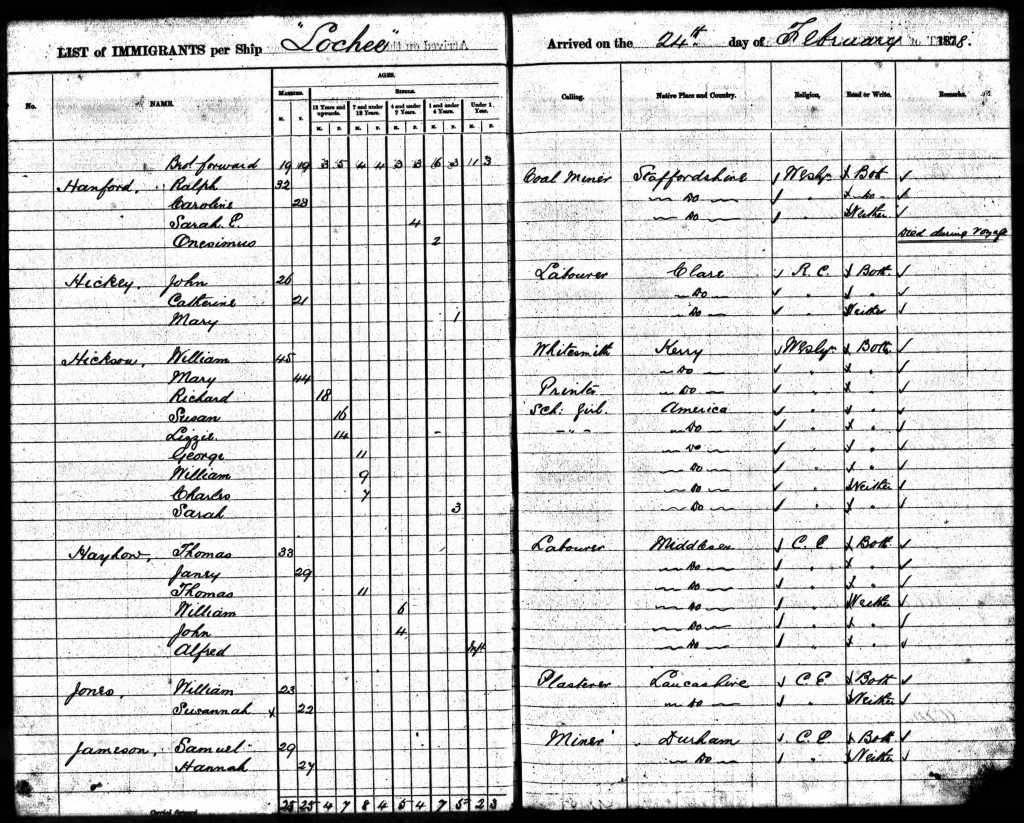
With the arrival of William and Mary and their children in 1878 the Richard Hickson line came to an end in Ireland. Many other Hickson families also migrated from Kerry, and settled in various parts of the world. There are doubtless still Hickson descendants in Kerry, but I have no contact with any of them.
Meanwhile, the descendants in Australia of Richard and Mary Hickson of Killorglin are many. Richard himself, the patriarch, lies buried in Providence, Rhode Island (USA), where he died in 1870, while his wife Mary’s bones lie in Killorglin (though I have not been able to locate her grave). But all of their children who grew to adulthood died in Australia and are buried there. Their descendants are scattered all over Australia, and around the world.
Note: if any descendants of these Hicksons, Needhams, Byrnes or Ruddles happen to read this blog, I would love to hear your stories. Post a comment below.
 Forgotten tales
You know how I love coincidences. Here is a new one : The Hickson family came aboard “Lochee”. The wife of James Byrne was born in Lochee, Dundee, Scotland. Means nothing in the scheme of things other than a small amusement. As always enjoyed reading your blog.
Well spotted… I wondered if anyone would look closely at the document. You have an eye for detail, Barb.