Australian and New Zealand troops landed at Gallipoli on 25 April 1915 in an ill-fated military operation intended to free the Dardanelles straits from Ottoman (Turkish) control in the First World War. The straits were of strategic importance as the sea route between the Mediterranean and the Black Sea, that is between Europe and Russia. The Ottoman Empire had allied itself with the so called Central Powers – the Germans and Austro-Hungarians – against the rest of the world, and the Turks thus became the first major “enemy” that Australian and New Zealand troops faced in the Great War. The campaign, which lasted the rest of 1915, was a military failure, due to a lack of good intelligence, and a lack of knowledge of the terrain, resulting ultimately in a complete withdrawal of the Anzacs, with the straits remaining in Turkish control. However, the bravery and dedication of the Anzac troops gave them a name in the global consciousness that continues to this day.
The Gallipoli landing has been commemorated ever since, every year on this day, 25 April, which is known as Anzac Day. I am writing this before dawn on 25 April 2020, a hundred and five years after that fateful day. The eastern sky begins to lighten, and Lake Macquarie to emerge from the darkness. The low hum of distant traffic is dominated by laughing kookaburras, screeching lorikeets, and the more gentle calls of countless other birds.
This will be an odd Anzac Day, because Australia, like much of the world, is in “lockdown” due to the coronavirus threat, which has paralysed the world. Usually at this time I would be heading down to Speers Point Park for the dawn service, but public gatherings are not allowed just now, and today people have been encouraged to simply stand on their driveways and hold a candle while observing a minutes’ silence to remember them, the fallen heroes of Anzac Day 1915, and all our Australian and NZ servicemen since that time.
0600 hours
The reveille sounds, a distant bugle somewhere out in the darkness, a distant rousing from sleep. There would have been no bugle sounds on that fateful day of the Gallipoli landing in 1915, when before dawn the troops poured out of their transports and crossed the beaches to the slopes that would be their home for the next 8 months. Maria and I carry lighted candles and stand in silence on our driveway, as neighbours emerge down the street outside their own homes, a silent, scattered gathering, to honour the fallen in every conflict. Gallipoli is so firmly entrenched in our national consciousness that even with the coronavirus lockdown we cannot let this day pass without remembering them, the soldiers, sailors and airmen of our armed forces that have helped shape our national identity over the last hundred years.
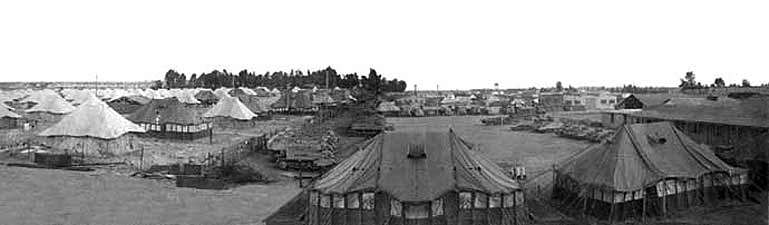
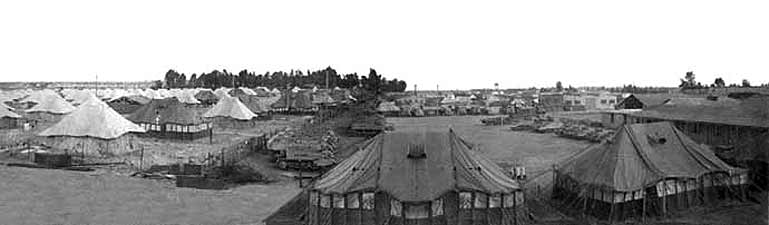
I have been thinking this last week about the first Anzac commemoration, on the first anniversary of the Gallipoli landings, 25 April 1916. Two of my ancestors had answered the call to arms, my great grandfather Charles Holdorf, and my great uncle, William Byrne. Both heard the reveille that morning in an army camp in the deserts of Egypt, as they prepared to go to war.
Major Holdorf
Charles Holdorf, my great grandfather, was an officer in the 8th Brigade of the 30th infantry battalion of The Australian Imperial Forces (AIF). He was not a young man, 47 years old in 1916, but he had been in the militia since joining the cadet corps in school in Goulburn, the little town in rural NSW, where he had grown up in the last decades of the 1800s. He had been a volunteer in the Australian Colonial Forces – there was no official Australian Army until the 1900s – by 1896 he was Second Lieutenant in the 2nd infantry regiment, becoming First Lieutenant and then Captain in the decade that followed. But his military appointments were all spare time activities – his day job was as a commercial traveller selling shoes in the Southern Tablelands of NSW.
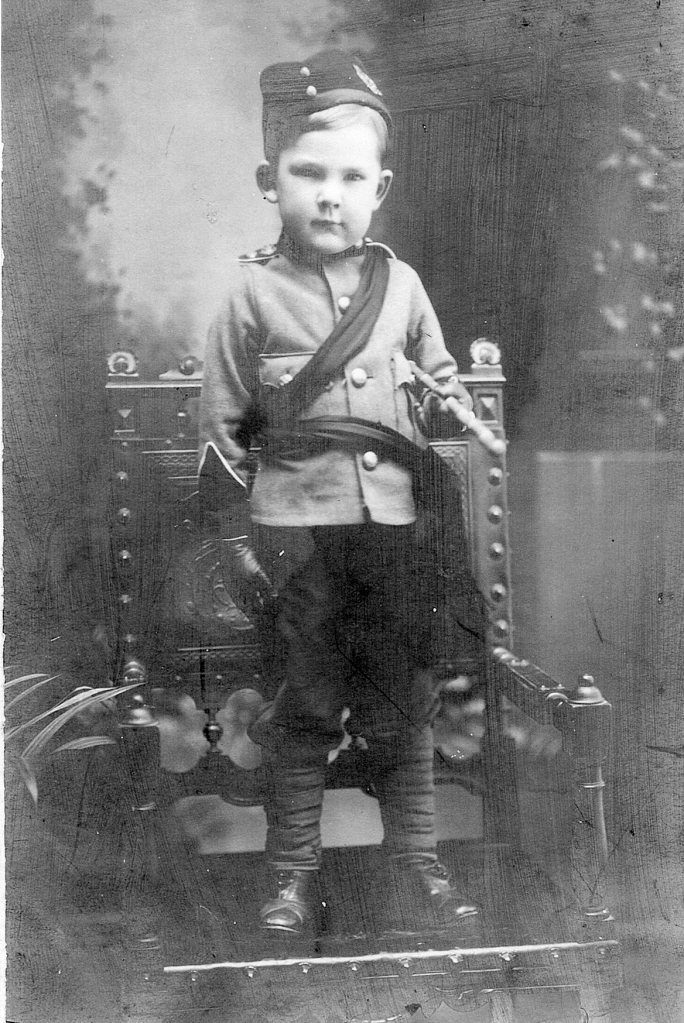
In 1898 at the age of 27 he married a lovely local girl named Florence Stacey, and over the next eight years they had five children, the first of which was my grandfather, named Charles after his father. Tragically, Florence died in 1906, leaving Charles a widower at 35. He never married again. Shortly after her death he moved to Sydney with his mother, who, herself a widow, was moving back to where she had spent her first years in Australia after arriving as an eight year old on a migrant ship from Hamburg. The Holdorf children were raised by their grandmother, initially in Ashfield, later in Manly. Their father was usually away, travelling for work, or taken up with army business. He would occasionally take his oldest son, my grandfather, with him to army functions, and Grandpa, who had his own regimental uniform, became affectionately known as the “little major” by his father’s army friends. The namestuck and he was called “Major” by his siblings for the rest of his life. But though he enlisted at 18 in the last year of WW1 he never saw active service in the armed forces. By the outbreak of WW2 he was regarded as too old to serve.
His father was really too old to serve in WW1 too, and initially he did not enlist. But the Gallipoli adventure must have exerted a profound effect on Charles, and given his long experience in commanding soldiers he was finally persuaded to enlist as a Senior Major in the 30th Infantry Battalion. He embarked in November 1915, and arrived at Suez on the 11 December, by which time the withdrawal from Gallipoli was underway. He spent the next 6 months in Egypt training soldiers for engagement on the Western Front. On the first anniversary of the Gallipoli landings he was in the Australian camp in Tel el Kebir, in the desert between the Suez Canal and Cairo. There he met many of the “original Anzacs,” battle hardened survivors of the now legendary campaign that had taken the lives of over 8,000 of their mates.
I imagine that Charles was relieved when he finally departed Egypt for France. The next 6 months on the Western Front were the only time this lifelong soldier was “in the line of fire” yet they became the defining 6 months of his life, as they did for every soldier who walked away from that horrendous time. The scars he carries, physical and psychological, left him profoundly affected for the remainder of his life.
Private Byrne
William Byrne had grown up in a strict Brethren family in the suburbs of Sydney, the only son of Irish immigrants who had come to Australia in the 1870s and 80s. He was born in 1894 and was 21 when he enlisted in Sydney in November 1915, just after Major Holdorf (of whom he had no knowledge) had sailed for Egypt. He had five sisters and a strict and distant father and had left home as soon as he could to find work in the country as a farm hand. He was experienced with horses and according to his enlistment papers he also had military experience. There is a section on the enlistment form that asks:
Do you now belong to, or have you ever served in, His Majesty’s Army, the Marines, the Militia, the Militia Reserve, the Territorial Force, Royal Navy or Colonial Forces? If so, state which, and if not now serving, state cause of discharge.
AIF Enlistment Paper for William Byrne, No 2148, 15th Reinf 7REG A L.H., 29.11.1915
Unfortunately the answer to this question is simply “2 years,” with no mention of exactly what military experience Will had. Perhaps he, like Charles Holdorf, had served in a militia in the country where he had worked. If he had served for two years, the start of his military service predated the outbreak of war, indicating an attraction to the army which was at odds with his strictly religious background. One can wonder whether his decision to join up caused tension with his parents. There is little doubt it provoked much anxiety for them and his five sisters. He was the only son. If he fell in battle it would leave a gaping hole in the family.
Presumably it was his experience with horses that led him to join The Australian Light Horse, the 7th regiment, and it was with that regiment that he sailed for Egypt. He arrived at the camp at Tel el Kebir on 14 April 1916, just 11 days before the first anniversary of the Gallipoli landing. Like Major Charles Holdorf he was rubbing shoulders with some of the already legendary Gallipoli veterans. It is doubtful he ever met Holdorf, however, since Will was in the Light Horse, while Charles was an infantryman.
A month later in late May 2016 Will sailed for England leaving his regiment behind. He had been transferred to another unit in the Light Horse, but would ultimately end up serving in the army service corps supplying ammunition to the front line on the Western Front.
Major Holdorf would not leave Egypt until June, when he sailed for Marseilles. Travelling on to northern France he was then plunged into the heat of battle, and within a month was involved in another Australian military disaster, at Fromelles. Private Byrne would not arrive in France from England until July, the day after the Battle of Fromelles commenced.
As far as I know these two men, the 21 year old Will Byrne and the 47 year old Charles Holdorf, never met each other. Charles was an officer on the Western Front for 6 months or so until he was invalided back to Australia in early 1917 with a lung complaint. Will ended up serving in the Army Service Corps, behind the lines, for the next 18 months. He was occupied in various Ammunition Sub Parks, eventually as a driver. He too was eventually invalided back to Australia, with a knee injury. Neither was wounded by gunfire or shrapnel in the conflict, and neither of them suffered long term adverse effects to their physical health. I can only speculate as to the effect on their psychological health, after being exposed to so much death and destruction.
Anzac Day 1916
Peter FitzSimons, in his recent book, Fromelles and Pozières, In the trenches of hell, recreates the scene in Tel-el-Kebir that first Anzac Day. Today, reading his description, I found myself imagining my ancestors on that day…
Dawn. For so many veterans of that extraordinary sunrise one year ago, it is hard to believe that the first anniversary of the Gallipoli landing is already upon them. And yet none are in doubt. It is a day for commemoration, of remembrance, of bowing your heads to pray for the souls of dear departed comrades. At Moscar, Ismaïlia, Ferry Post, Tel-el-Kebir and in Cairo, church parades are held ’to commemorate the landing and the lads who fell on the Peninsula.’
FitzSimons P, Fromelles and Poziéres, pp 148-150
All those Diggers who were at the landing on the day have a red ribbon hanging from above the left breast pocket, while those who had seen service in the Dardanelles are entitled to a blue ribbon worn above the left breast pocket. With the services completed the troops are given the rest of the day off from training to participate in sporting events and enjoy concerts.
The grandest commemoration, however, is in London, on a balmy day, where a memorial service is held in Westminster Abbey, attended by 3000 people…
At the conclusion of the magnificent service, marked by a haunting rendition of ’The Last Post’ by 16 trumpeters, many of the Australian soldiers are invited back to the Hotel Cecil, where their Prime Minister addresses them in a speech for the ages:
’Soldiers of Australia… on this day, called Anzac, one short year ago, the Australian soldier leapt unheralded into the arena of war, and by a display of courage, dash, endurance and unquenchable spirit, proved himself worthy of kinship with the heroic men who throughout the history of our race have walked unafraid into the jaws of death, thinking it glorious to die for their country… I feel that the spirits of those dauntless men whose bodies now lie on the Peninsula are not far from us on this day of Anzac, urging us to press on, and ever on to the victory. They gave up their lives for their country and their liberties. Their deathless deeds will yet be sung in sagas to generations of Australians to the end of time.’
Does Anzac Day glorify war? I don’t think so. Rather it glorifies self sacrifice, the willingness to give everything for the sake of a cause that is bigger and more important than ourselves. Or for the sake of our friends. Ultimately for the sake of love. The Gallipoli landings cemented these values in the consciousness of Australians soon after this little remote outpost of the British Empire became a nation, values that were taught millennia ago by Jesus, my greatest hero. ”Greater love has no man than this, that he lay down his life for his friends.” For that reason, because I believe that we are in ever increasing danger of forgetting these values that can lift us out of our self obsessed lives, I think that it is good that we continue to celebrate Anzac Day.
At the going down of the sun, and in the morning, we will remember them.
 Forgotten tales
Thank you David.
Thank you David,
Great read! Do you mind if I steal your passages of Will Byrne to add to my ‘Family Tree Byrne’ work of love? ( * ) Which by the way is all but complete, well, as we both know, family history remains a work in progress. I am pleased with where I am though, requiring only a few ‘cover pages’ and minor tweaks to be able to put it aside. I suspect I am dilly dallying with them to keep the Byrne Family close.
My ANZAC observance was from my balcony (no driveways in Paddington). Living close to the back of Victoria Barracks I was able to hear The Last Post and Reveille mark my minute silence. Remembering great uncles who served in WWl; my dad, his five brothers and sister of WWll and the boys I went to school with, whose number came up for Vietnam.
Strange times we are living through. I hope you and Maria are able to stay safe in your practice. What stress you must be under. I am in the middle of my radiotherapy and am keeping away from everyone – don’t want anything to interfere with my treatment.
My poor little white fluffy thing (dog) can’t understand why we are not taking advantage of the glorious autumn and spending our days in ‘The’ park. All those people working from home have suddenly discovered Centennial Park, never seen so many people.
BTW I did tune into your church service over Easter, must say your vicar (?) is most impressive. I can see why you would want to spend time with her.
Take care. I look forward to meeting up when the plague has passed.
(* ). Will give you credit
B😷
Sent from my iPad
Hi Barb, you are always welcome to steal anything from my blog, though I can’t vouch for it being completely accurate! Sorry to hear that your poor little white fluffy thing is suffering under the shutdown. Stay safe!
Thanks Dave; I really enjoyed this one.
Dear David,
You weave the stories together well. A good read.
Thanks Peter! Hope all is well with you in lockdown!
great story. I had a grand uncle who was a doctor in Gallipoli in the British Army.
Thanks Simon. We Australians tend to forget the thousands of others who were at Gallipoli. It has become he Australian and New Zealand campaign in our minds. Yet many more lost their lives from Britain, and of course the Turks. Maybe you could write your uncle’s story?
David, it may be worth mentioning that my grandfather, Charles Holdorf, most notable service on the Western Front was as second in command of 30th Battalion at the infamous Battle of Fromelles in northern France on 19/7/16 when a record no. of Australian soldiers were killed in one night. He was later promoted from major to Lt. Colonel, but this rank was changed back to major when he was invalided back to Australia on 12/4/17. His army service was terminated on 17/10/17.
Hi Dad, you stole my thunder. That’s going to be the subject of another blog!
Hi David,
I know I’m late in sending this but you did have other family members at Gallipoli and in France from the Fischer/Fisher side of your family. Frederick Charles Fisher Service No 218A & Leslie Gladstone Fisher Service No 550. Take care
Hi there,
The further out I go on the branches of the family tree, the more WW1 soldiers I find. Pauleen Cass has written a brilliant blog about Les and Fred which you have no doubt seen: https://cassmobfamilyhistory.com/2014/04/25/two-brothers-go-to-war-les-and-fred-fisher/. I am still trying to get my head around my more direct ancestors – brothers Charles and Lewis Holdorf, and Will Byrne, but I know there are more out there. Would be happy if you directed me to any others you know of. Thanks for getting in touch.