Legends of the Lakes
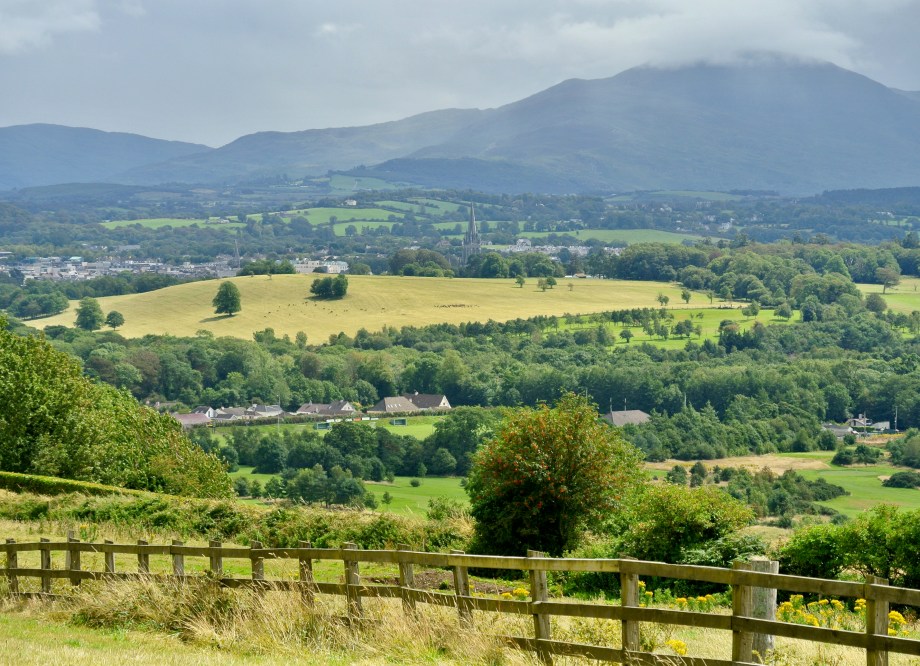
In 1829 a travel book was published with the extremely long title of Legends of the Lakes; or Sayings and Doings of Killarney. Collected chiefly from the manuscripts of R. Adolphus Lynch Esq. H.P. King’s German Legion. By T Crofton Croker. The book can be accessed and downloaded online, and was brought to my attention by my distant relative, Barbara Fromberg of Centennial Park, Sydney, with whom I share an ancestor who appears in the narrative.
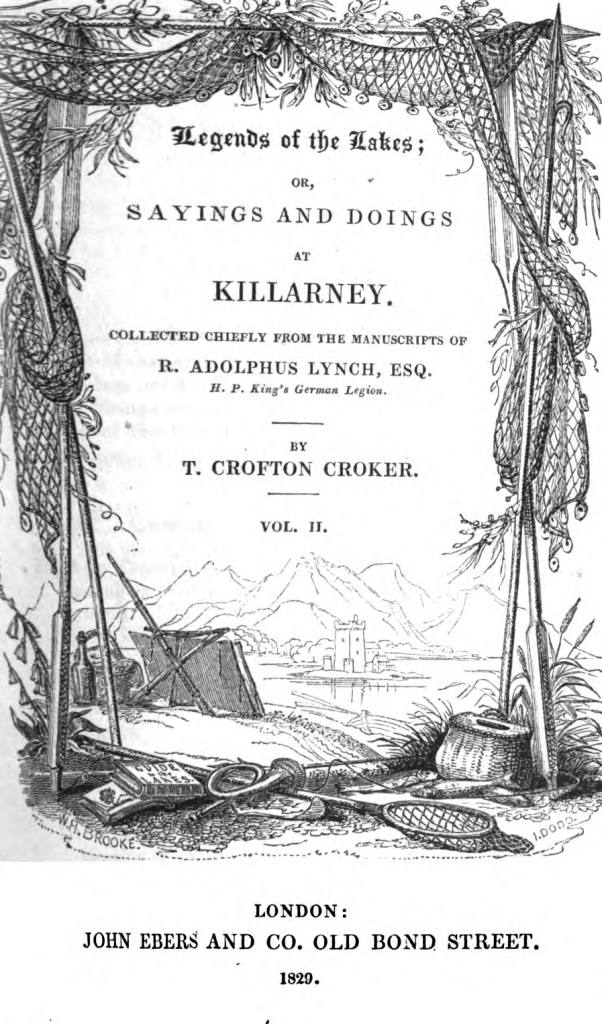
The book is a fascinating ramble through Killarney and its environs almost two hundred years ago, when Killarney was already a tourist destination, even before the infamous famine struck Ireland. It is written as a conversation between the narrator, the author, Thomas Crofton Croker, and Mr Lynch, presumably the writer of the manuscripts referred to in the title. It depicts a fictional tour of the Lakes as a background to relating the local legends of Killarney and County Kerry, in south-west Ireland. NC Hultin, in a journal called Folklore (1), writes,
The characters who appear in it are historical, well known to nineteenth century visitors to the lakes, and frequently mentioned in local guidebooks and histories. Croker invented the excursions, though they are to the usual sites, and joined them to local legends for a tour which would leave even a modern tourist breathless…
Belief and Interpretation in T Crofton Croker’s Legends of the Lakes. N. C. Hultin, Folklore Vol. 98, No. 1 (1987), pp. 65-79. https://www.jstor.org/stable/1259402
One of the historical characters who is mentioned in the book is a certain Thomas Ruddle, who is Barbara’s and my common ancestor, my grandmother’s great grandfather. He appears in passing in chapter 6, where Croker describes a Sunday in Killarney.
A Sunday in Killarney
I returned to Gorham’s (Hotel), where I was agreeably surprised by the appearance of Mr Lynch, who had been awaiting my return.“I see you have been out early, said he, “what do you mean to do with yourself today?”“I mean to witness a Sunday in Killarney…”“Then I promise you,” said Mr Lynch, “full employment, notwithstanding that it is the sabbath day. So soon as you are done breakfast, we woill take a turn as far as Woodlawn, after which we can go to church, then stroll through the town, if you please, and make our observations.”“Agreed,” said I, and when I had finished breakfast, we set off on our walk…”
pp61-62 Legends of the Lakes
The chapter that follows is a series of observations of the activities of the locals, including some of the religious beliefs of different parts of the community, notably the Catholic majority, the Protestant minority, and some non-conformists – Methodists – who appear at the end of the chapter. The only church service that Croker and Lynch attend is the Church of Ireland in the middle of town, a reflection, I suppose, of their Englishness. It is there that they meet Tom Ruddle:
The church is directly opposite Gorham’s Hotel, and though not a very splendid edifice, has a look of neatness from its iron railings, little shrubbery in front, and steeple, which is a wooden structure covered with slate. At the gate we found two or three constables or Peelers doing the duty of beadles, and ready to prevent any disturbance (a necessary precaution) about the church during the time of service. On our entrance we beheld a tolerably extensive congregation; but this was owing to the influx of strangers, as there are not many protestants in or around Killarney. The interior of the church, though neat, was very plain, possessing but one small gallery, where sat the little choir; its front decorated with the arms of England, supported by the lion and the unicorn. Along the walls were certain monumental inscriptions; among which might be seen those to the memory of Earls of Kenmare; for though a Roman Catholic family the church contained their mortal remains. In the window over the communion table was a small transparency representing, as I was told by the pew opener, the Last Supper, at which, if it be so, two of the disciples only are represented. The congregation appeared clad in the “Sunday’s best,” each scrutinising his or her neighbour, for the laudable purpose of after church criticism, and morning-visit conversation. While in all the pride of place, if I may be forgiven for applying the phrase to churchmen, stood the Reverend Arthur Hyde, with his clerical sub, the Rev. Mr Bland in the reading desk, nor must I forget to mention the best possible of all clerks, Mr Thomas Ruddle.
pp68-70 Legends of the Lakes
The church service passed as usual, without anything in particular, except that the clerk read a great deal better than the clergymen, who, however, did not perform badly. Mr Bland then ascended the pulpit, and delivered a moderate, and at the same time an eloquent discourse, in which no sectarian acidity was subtilely mingled with the sound doctrines of the Church of England, or the pure charity of christian principles. pp68-70
Thomas Ruddle
It is nice to meet an ancestor in a published book, especially when he is described as “the best of all possible clerks, Mr Thomas Ruddle.” However, he is something of a mystery to us. The only objective documentation that we have found about him is in the Church Records of County Kerry, notably the marriage record of his daughter Sarah, to George Byrne. Thomas appears there as Sarah’s father, and his occupation is listed as Parish Clerk, which corresponds nicely with the story told by Thomas Crofton Croker. However, Sarah and George’s marriage was in 1857, twenty eight years after Croker’s book was published. Sarah, who was born in 1834 or 1835, had yet to come into the world.
Despite lots of effort, especially on Barbara’s part, we have not been able to work out where this Thomas Ruddle came from, nor where he ended up. We have not found a birth, death or marriage record for him. Was he born in Kerry? Or was he from further afield, Limerick or Cork, where there seems to have been many Ruddles, or even England? Or was he descended from the Palatines, a persecuted group of Protestants which escaped from Germany in the early 1700s, as suggested by Kay Caball, a Kerry historian and blogger, who says that Ruddle, or Ruttle, is a Palatine name. Although many Palatines migrated to America, others were enticed to migrate to Ireland by wealthy Irish landowners who wanted to increase the Protestant population of their tenancies.
Thomas appears many times in the Church Records as a witness to marriages in the Killarney Church of Ireland. Various other Ruddles appear to have acted in the same capacity, especially Robert Ruddle, whose main involvement was with another Church of Ireland, in nearby Aghadoe, which as it turns out is where at least two of Tom’s grandchildren – Sarah and George’s first two children – were baptised. However, the relationship of Robert or any of the other Ruddles to Thomas is not clear.
Religious Kerry
Kerry was a very religious place in the 1800s. The majority of the population was Roman Catholic. Croker depicts them as a superstitious lot, but very devout, with a strong focus on saints and miracles and the Virgin Mary, which I suppose for him form part of the “legends of the lakes”. He speaks of the tensions between Catholics and Protestants, and of the conversion of certain individuals. He speaks of a prominent family – the Earls of Kenmare – who were apparently Catholic but whose tombs were in the Church of Ireland church. He portrays the Methodists and other non conformists as intolerant types who thrived on religious controversy. Only the Church of Ireland comes off in a generally positive light, perhaps a reflection of the fact that Croker and his companion were almost certainly themselves Church of England: Mr Bland then ascended the pulpit, and delivered a moderate, and at the same time an eloquent discourse, in which no sectarian acidity was subtilely mingled with the sound doctrines of the Church of England, or the pure charity of christian principles.
This was the Killarney that Thomas Ruddle, his family, his daughter Sarah, and her family lived in. There is more to the religious story of Sarah and George Byrne’s life than the Church of Ireland. Ultimately they appear to have slipped into the Plymouth Brethren, a movement originating in Dublin that sought to return to a truly Biblical practice of faith, turning their back on church traditions which they felt had no basis in Scripture.

Today there are few if any Brethren assemblies or Methodist churches in County Kerry, and precious few Church of Ireland congregations. The Killarney Church, which is now known as Saint Mary’s (not to be confused with St Mary’s Cathedral, which is the Roman Catholic Cathedral in Killarney) is one of the few COI churches in Kerry that is still functioning, though it is much changed from the time Thomas Ruddle’s family worshipped and worked there. I visited last year when I was in Kerry for a week. Most of Kerry’s Protestants have gone, having left in the latter part of the nineteenth and early part of the twentieth centuries. Sarah Byrne’s three sons all came to Australia in the 1880s and 1890s. The future looked brighter on the far side of the world. Having said that, it was not necessarily religious persecution that drove them away, for there were surely more Catholics that left Kerry than Protestants.
Kerry today is much more Roman Catholic than in the 1800s. Who knows if it will remain that way with the march of secularism through the Western world.
Presbyterian, Wesleyan, Church of Ireland … when the final crash comes – if it will come – we shall be crushed or swept into the North Channel together.
(Sermon, 1886, Rev Nicholas Foster. Quoted in The Church of Ireland in Co Kerry, by J Murphy and E Chamberlain. 2011)
 Forgotten tales
Dear David,
Great reading as usual. Always appreciated.
Peter.
Thanks for reading Peter! Hope all is well with you.