
This is the second in a series of blogs about the Protestant churches in Co Kerry that my Irish ancestors attended. Protestants in Co Kerry have always been a small minority of the population, but they gradually increased from the time of the Reformation to the 19th century, peaking at just under 5% in 1861. During the first half of that century many new COI churches were built in Kerry, and some of those new churches became spiritual homes to my ancestral families. Here is an overview of that time.
The rise and fall of the Church of Ireland in Kerry
In 2011 two Kerry women, Janet Murphy and Eileen Chamberlain, published a brief history of the Church of Ireland in Co Kerry during the nineteenth century. In the introduction they write:
In the first half of the nineteenth century, the Church of Ireland erected more than five hundred churches, licensed 172 schoolhouses for Divine Service and increased its clergy by almost a thousand. A church building programme funded by the Board of First Fruits brought ‘no end to applications from all quarters for enlarging and rebuilding churches’.
‘All quarters’ included Co Kerry and during the course of the nineteenth century, forty-eight churches were built, rebuilt or enlarged, the majority before disestablishment in 1871. Of those forty-eight, thirteen remain in use today, twelve have been demolished, eight are in ruin, fourteen have been sold or leased and one is closed. Almost no local memory remains of the ruined or demolished churches. Within the walls of those buildings however, children were baptised, couples were united in marriage, and individuals received their final blessings. For these reasons, this work has been compiled as a record of the sacred buildings lost, and of those which remain. More importantly, it remembers the lives of those associated with them.
(The Church of Ireland in Co Kerry. A record of church and clergy in the nineteenth century. J Murphy, E Chamberlain. December 2011.)

Given the history of the Establishment (Protestant) Church in Ireland over the preceding two hundred years, it would be easy to assume that the explosion of new church building in the 1800s was simply part of a British strategy to suppress Catholicism, a weapon in its arsenal to attack and weaken Irish identity, and therefore Irish resistance. However, as the quote above observes, new churches were built and old ones enlarged in response to applications from people who felt they were needed. In Kerry, one of the least Protestant of Irish counties, with a total population of around 231,000 in 1851, forty eight churches were either built, renovated or enlarged, which equates to one church for every five thousand people (of whom not more than 250 would have been Protestants), remarkable in a Catholic county. Despite Catholic antagonism, famine, and massive emigration, the number of Protestants was growing through the first half of the 1800s, and they wanted somewhere to worship. For whatever reason, some Catholics must have been converting to Protestantism, since the church was growing.
There was, however, a problem in the way this expansion took place. Although the establishment of new churches was in response to growing numbers of Protestants, the finance for new buildings was provided by the Government (through the “Board of First Fruits”), by taxation of the general Irish population, which was largely composed of Catholic tenant farmers. Such a policy could only ever lead to resentment, not just toward the British Government, but toward the Church of Ireland and the local people who attended these churches. Catholics who converted were often persecuted and Protestants who tried to proselytise – to persuade Catholics to convert – were treated with suspicion and distrust. Anger amongst Catholics who were forced to pay taxes to support a church of which they were not a part resulted in a “tithe war” which would be the undoing of COI growth. The British Government eventually gave in to demands and the result was “disestablishment,” when the Church of Ireland ceased being the “establishment church” for the first time since Henry VIII.
From 1871 the COI had to rely on its own financial resources, and any privileges enjoyed by the Protestant minority were increasingly eroded. However, rather than taking the pressure off the Church of Ireland, this achievement only increased anti-Protestant sentiment, which became a major catalyst for Protestant emigration from Ireland, though financial hardship and the promise of a better life in a distant land played a major role too, as it did for Irish of all religious persuasions. Protestantism, sadly, had become for many a symbol of British imperialism, rather than a religious movement for reforming the excesses of the Roman Church.
From the 1860s onwards all my Irish ancestors emigrated, though some of the families had been in Ireland for centuries and some were descended from even more ancient Irish families. They were all Protestants. Most of my ancestors left Ireland for America or Australia. Some of their extended families went to South Africa (Needhams) and New Zealand (Hicksons), and no doubt other places too. I know of no Hicksons, Needhams, or Ruddles that remain in Kerry. There are certainly Byrnes, since that name is ubiquitous in Ireland, but none to which I can establish a connection.
Five family churches on the Ring of Kerry
Five COI churches were significant in my family’s story in nineteenth century Kerry: Killarney, Aghadoe, Killorglin, Sneem, and Templenoe. Only one of these existed in 1800, namely Killarney. All the others were built during the COI expansion in Kerry in the first half of the 1800s. Yet today only two remain in use, Killarney and Sneem, though Killorglin has a new COI church which in 1997 replaced the one that my Hickson ancestors attended. The churches in Aghadoe and Templenoe are both closed, but still standing. When I was in Kerry last, in the summer of 2019, Aghadoe was boarded up and Templenoe appeared to be privately owned and possibly in use as a residence. At the time of writing, Aghadoe Church is being advertised for lease.
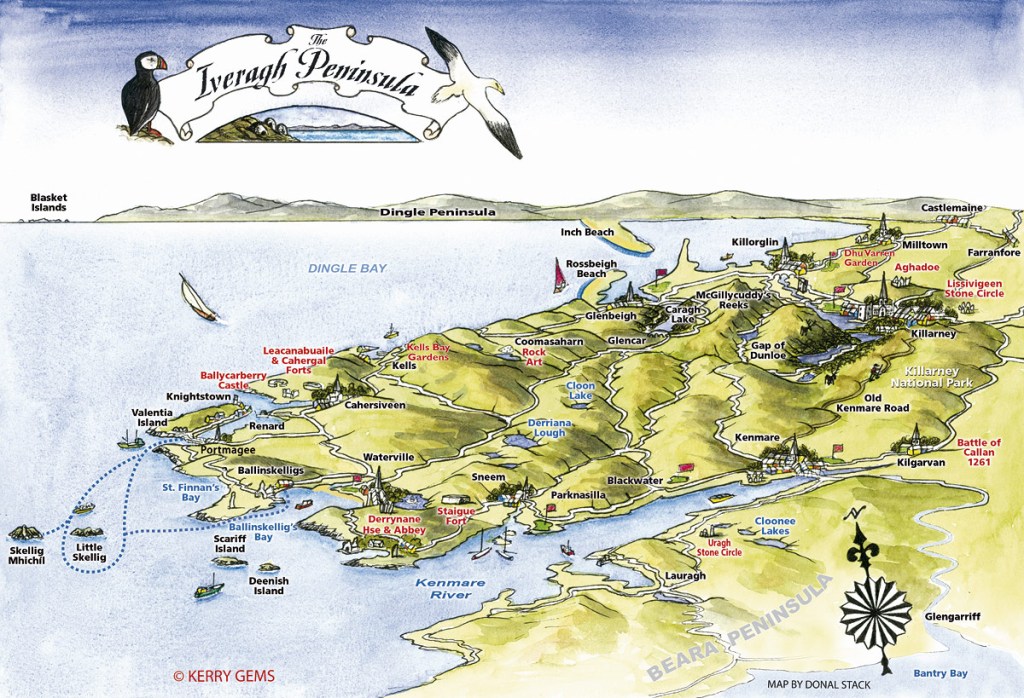
Interestingly, all of these churches lie on the now well known tourist trail known as the Ring of Kerry, which is really a route roughly following the coast of the Iveragh Peninsula, which lies to the west of Killarney (see map above). The centre of the Iveragh Peninsula is mountainous, and includes the highest mountain in Ireland, Carrountoohil, in the MacGillicuddy’s Reeks, which towers above the Lakes of Killarney. The map above shows all the places my ancestors lived, except Templenoe, which lies just to the east of Blackwater on the road to Kenmare.
The Killarney church, which is nowadays known as St Mary’s “Church of the Sloes,” is somewhat changed from the building in which the Ruddles and Byrnes worshiped in the nineteenth century. It has always been something of a tourist church, certainly since Killarney became a popular tourist destination after the visit of Queen Victoria in 1861. Though its present day population is rather small, it swells in the summer months when tourists are plentiful. The church hosts free summer music concerts and an early service on Sundays to accommodate tourists leaving on day trips around the Ring of Kerry. Nearby is the main departure station for the jaunting cars which carry tourists around Killarney, its lakes and into the mountains.
Heading counterclockwise on the Ring of Kerry it is just a short detour on the northern side of Killarney to the Aghadoe Church, built in 1837, now closed, which stands amid stone walls and green fields. Coming back to the main road one travels on to Killorglin, where the third significant family church, St James, built in 1809, still stands, as mentioned, though it is now a restaurant rather than a church. After Killorglin comes Sneem, on the other side of the Iveragh Peninsula. It is a good way from Killorglin if one follows the Ring, but can be reached much more quickly by driving directly south across the mountains to get there. The Sneem church was built at the same time as the Killorglin Church, though it was significantly renovated in 1967, and is still functioning. Nowadays it is known as the Church of the Transfiguration.
Following the road eastward toward Kenmare one crosses the famous Blackwater Bridge before coming to a village called Templenoe, where the fifth of my family’s churches stands. It was built in 1816, and was the parish church of the Mahony family, owners of the nearby Dromore estate. My ancestor, (great great great grandfather) George Needham, was the parish clerk.
From Templenoe it is a short drive to Kenmare, then up over the mountains and back down to Killarney, which completes the Ring route. The Ring of Kerry forms the circle of my ancestral families’ lives. Their churches are all still there, but only two of them still function as churches. As Murphy and Chamberlain say in their book, “within the walls of those buildings … children were baptised, couples were united in marriage, and individuals received their final blessings.” My ancestors were some of these.
In the next few blogs in this series I will describe these churches and my ancestors roles in them in more detail.
 Forgotten tales
Sent from my iPad
Hi David,
I haven’t had time to read your most recent blog, BUT on another note. Today in the ‘culling process’ I found a hand written note from my mum, obviously meant for me to discover some years ago. She states that her Dad (James) was born in 1865. I always thought it was 1866. Well there you go! He was born in December so that would have some impact on resource material. Of course in my search for him I have been looking 1860 to 1870. Well here I go again, just in case I have missed something.
My BYRNE folder gets bigger by the day and I fear with your input it is going to become even more extensive. When ever am I to get onto the Lawrences, the Schofield’s, the Bushells, the Roses? Then there are the Frombergs and the Gurshinis! I need to live to be 120!!!
Heading up to the vineyard on Friday for a couple of days – returning Monday or Tuesday at the latest. If you and Maria (et al) would like to drop by you would be most welcome. A bit of notice could produce a delicious slow cooked shoulder of lamb (a’la Michel Roux – a connection I will explain over lunch). Would love to see you. Need to know before Friday to collect said shoulder from my Sydney butcher. Can’t promise a French chateau. – think little log cabin in the bush, but the tucker will be good and the wines excellent, family dysfunctional 😃.
Truely would love to see you.
B.
Sent from my iPad
Hello David,
Thank you for all your work and your wonderful blog. My Protestant Irish ancestors came from Kilgarvan, Kerry, and there was/is a church there as well. (Kilgarvan is just to the east of Kenmare so not on the Ring.) The church was restored some years ago and used as a ‘developmental centre’ for a few years but it is no longer open. However, the church is still standing.
I also assume you know of the Protestant church in Kenmare but your blog is focused rightly on your family history. There were also Aldworths in Sneem and Templenoe and some of these Protestants converted to Catholicism — supposedly because of a supercilious Protestant rector.
Patricia Aldworth
Hi Patricia, thanks for making contact. It’s amazing how many Protestant churches there are in Kerry considering how few Protestants there are. Most of them it seems are unused now. It’s been fascinating for me to get to know these churches a bit better. I smiled when I read what you wrote about Templenoe. It was one of the Mahony family that was the greatly disliked Protestant rector. His son, who succeeded him, was apparently quite different and was the catalyst for the 1861 revival in Kerry. I have written a little about the Mahonys on other blogs but I hope to write more soon. Fascinating to hear about the Aldworths, who must have known my Needham ancestors. Have you been to Kerry yourself?
Loved reading this. My fathers family were Church of Ireland, Ballydavid, Caherdorgan and used the small local church there.
Hi Martina, thanks for commenting. I looked up the church that your father’s family must have attended. The nearest COI to Ballydavid seems to be Kilmalkedar (Ballyferriter), on the north coast of the Dingle Peninsula. There is a picture of it at https://www.geograph.ie/photo/6096416 though it appears to be called Murreagh Church in this picture. It was built in 1866 and deconsecrated in 1984 and sold. I cannot explain the names, but this picture resembles exactly the picture in the book I have on the Church of Ireland in Kerry. There appears to be a Catholic Church in ruins in the same area which is much better known.