
This is the fourth in a series of blogs about my family’s involvement with the Church of Ireland in Kerry in the nineteenth century.
The Hicksons of Kerry: commoners and gentry
There have been lots of Hicksons in Kerry in the past, ever since the first one, an English clergyman named Christopher Hickson came over from England in the 1500s during the Elizabethan “plantations.” He was Church of England of course, but his descendants are a mixture of Protestant and Catholic. His own son was the first to adopt the Catholic faith, and suffered exile to Connaught at the hands of the English, for being a “rebel and a papist.” He eventually returned to Kerry. Since that time some four hundred years have passed and many Hicksons have been born and died. As far as I am aware most of those who retained the Protestant faith have, however, departed Ireland to become part of the Irish diaspora around the world. My Hickson family were some of them.
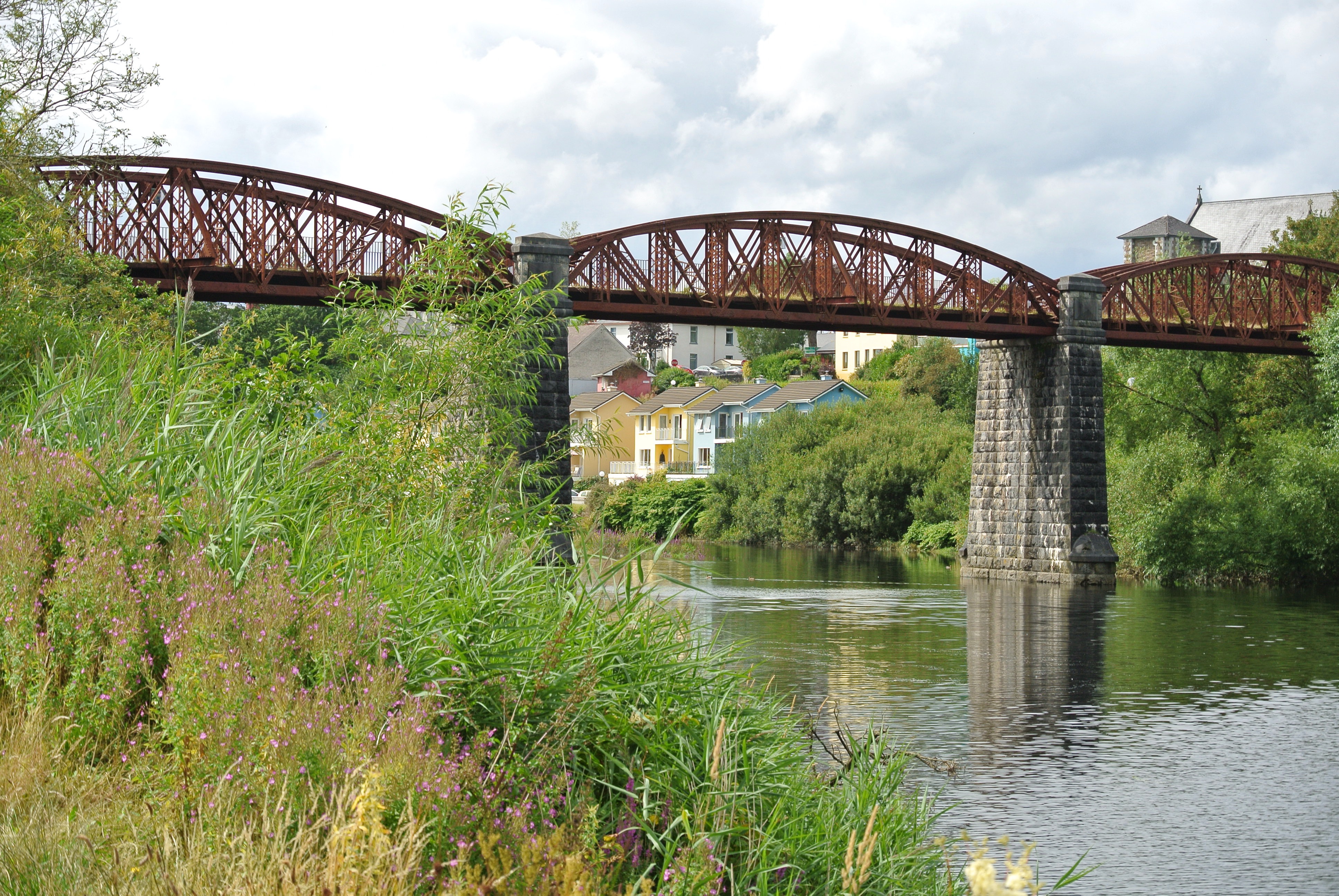
I have only been able to trace this Hickson line with any certainty back to the early nineteenth century. I am descended from Richard (ca 1800-1870) and Mary Hickson of Killorglin on both sides of my family. Richard and Mary had at least three sons, though likely more, but only three survived to adulthood. The oldest, William (born 1833), was my mother’s great grandfather. The youngest, John (born 1848), was my father’s great grandfather. My parents, it seems, were unaware of their distant connection when they married.
Despite the difference in their ages (15 years), William and John were very close. John no doubt loved William as only a little brother can do, and William, I suspect, doted on John. Their mother died when John was only five, which must have been devastating for the little lad. William by then was twenty, and worked as a nail maker. Five years later he married, and I have wondered if John, then ten, may have lived with his brother and sister-in-law for some time after their marriage. William and Mary’s first child, Richard, was born in 1859, when John was 11, and from his later writings it is clear that John was very fond of his nephew. William and Mary’s second child, Susie, was my mother’s great grandmother.
Just as there were Protestants and Catholics in the wider Hickson family, there were gentry and commoners. Although “my Hicksons” were ordinary people, not too far away on the Dingle Peninsula there were a number of related Hickson families who were well known among the Kerry gentry, a connection that John in later life would subtly drop into small talk with Sydney socialites. Perhaps he was subconsciously compensating for his wife Martha’s rather less respectable background: her parents had been convicts, transported from England and Ireland respectively. Convict ancestry did not confer quite the same social status in the nineteenth century as it does now.
In contrast to my Killorglin Hickson family, the Hickson gentry in Kerry appear in the history books. Various Hicksons appear in Burke’s Landed Gentry, a “reference work listing families in Great Britain and Ireland who have owned rural estates of some size,” and of which successive editions were published through the nineteenth and twentieth centuries. The Hicksons owned or lived in some of the so called “big houses of Kerry,” and the Griffiths Valuation, the Kerry section of which was completed in 1853, lists many of these.
One particular house in Dingle, The Grove, connects my ordinary Hickson ancestors to the aristocratic Hicksons of Kerry, because John Hickson in his later writings referred to this house as his family’s “ancestral seat,” an odd claim considering the fact that he apparently never lived there, nor does he anywhere explain how he and his family were related to the Hicksons of Dingle. They had the same name, to be sure, which indicates a common ancestor. But did John or his family have anything to do with the old house during their early lives in Ireland? Other “big houses” in Kerry were owned or occupied by Hicksons, but it is only The Grove that John mentions in his writings as having significance for his family. Was the house in any way part of John’s childhood, between 1848 when he was born, and 1868 when he emigrated?
William and John’s father Richard was born around 1800. At that time The Grove was occupied by a certain Robert Hickson, who had two sons who were a few years older than Richard, namely Robert (b.1786) and George Hickson (b.1795). Both of these contemporaries of Richard became clergymen in the Church of Ireland, and would presumably have been known to him. By the time of the publication of the Topographical Dictionary of Ireland, in 1837, The Grove was the residence of another Hickson. The following extract indicates that there were two Hickson families in big houses around Dingle in 1837, John Hickson at The Grove and Murray Hickson at Balintagart:
The principal seat in the vicinity is Burnham House, the property of Lord Ventry, and now the residence of his agent, D. P. Thompson, Esq., who has much improved the house and demesne. Burnham is situated on the S. W. side of the harbour (on the border of the adjoining parish of Kildrum), and commands a fine view of the town and harbour of Dingle, and the range of mountains at the foot of which they lie. The other seats are, the Grove, the former residence of the Knights of Kerry, now of J. Hickson, Esq., situated in a finely wooded demesne immediately adjoining the town; Monaree, of the Hon. R. Mullins; Farinikilla, the modern mansion of P. B. Hussey, Esq.; and Balintagart, of S. Murray Hickson, Esq.
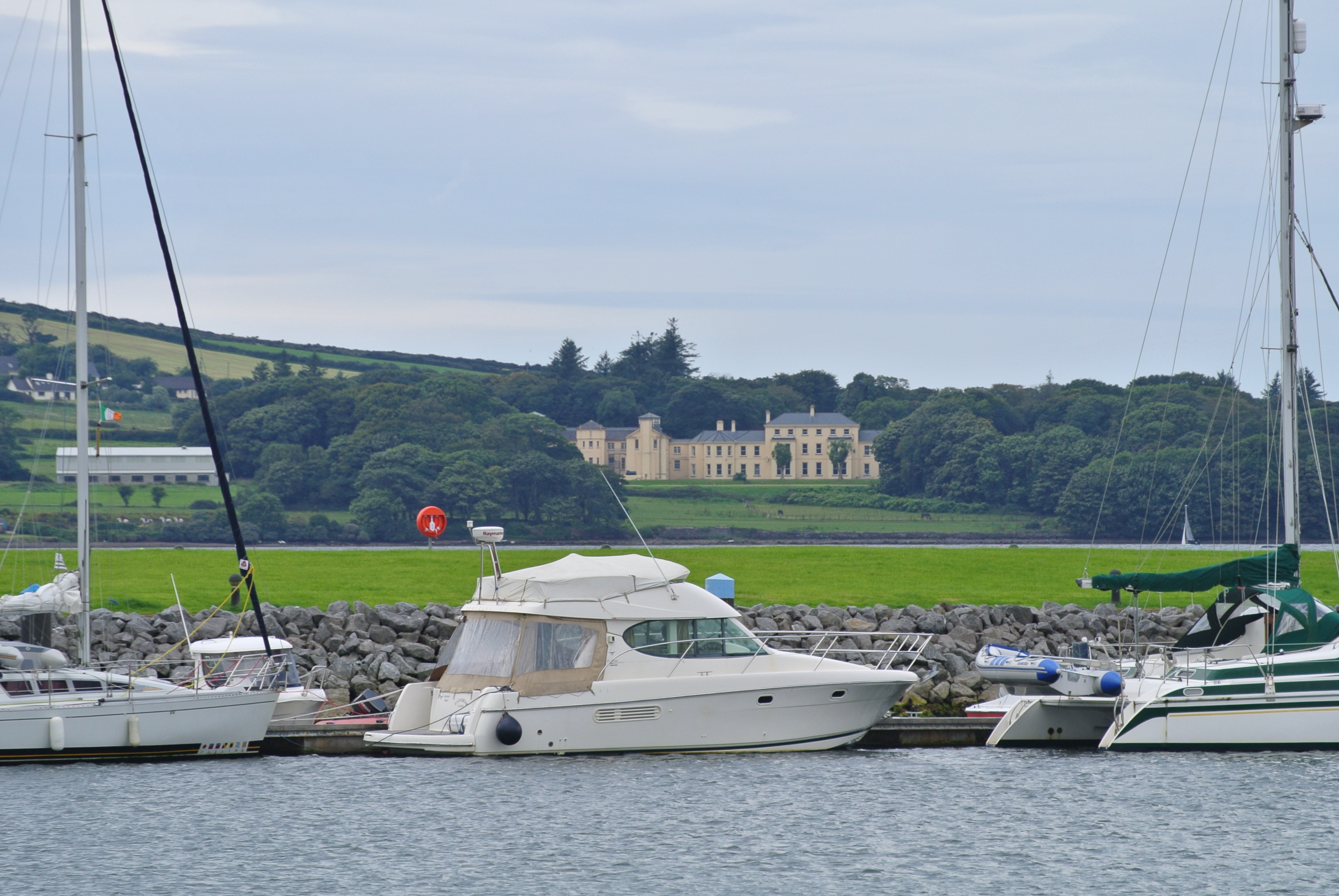
The Griffith’s valuation for Kerry, recording home occupancy in the 1850s, states that “Mrs John Hickson,” presumably the widow of the aforementioned J.Hickson, was leasing the house from the Rev Maurice Townsend. Who succeeded her as the occupant of The Grove is unclear, but it would seem that Hicksons continued to reside at The Grove until toward the end of the 19th century.
But exactly how any of these was related to the Killorglin Hicksons I have yet to discover.
The Hicksons and the Church of Ireland: clergy and parishioners
Various Hicksons had been closely connected with the Church of Ireland (COI) since their common ancestor, Christopher, an Anglican clergyman, arrived in the 1580s. Richard and his wife Mary were members of the COI congregation in Killorglin. When Richard was a boy, in 1809, a new COI church was built in Killorglin, St James, one of many new churches built all across Ireland during the nineteenth century, at a time when the COI was rapidly expanding.
This explosion of church building reached its peak around 1870, but came to an abrupt stop after Dis-establishment, in 1871, when the COI ceased being the state church in Ireland for the first time in 300 years, with a resulting loss of state funding. Combined with the massive Irish emigration of the nineteenth and early twentieth centuries, this led to dwindling congregations which could not afford to maintain the churches that had been built. Many COI churches in Kerry fell into disrepair and were closed; some were eventually demolished with no trace remaining today. Relatively few still function as places of worship. St James COI in Killorglin is one of those that remain standing but no longer function as churches. It is now a tapas restaurant. A new Church of Ireland was built nearby in 1997, almost 190 years after St James was opened. The new church is named St Michaels, no doubt to distinguish it from the Roman Catholic church in Killorglin, built in 1890, which oddly enough was named St James, like the COI church.
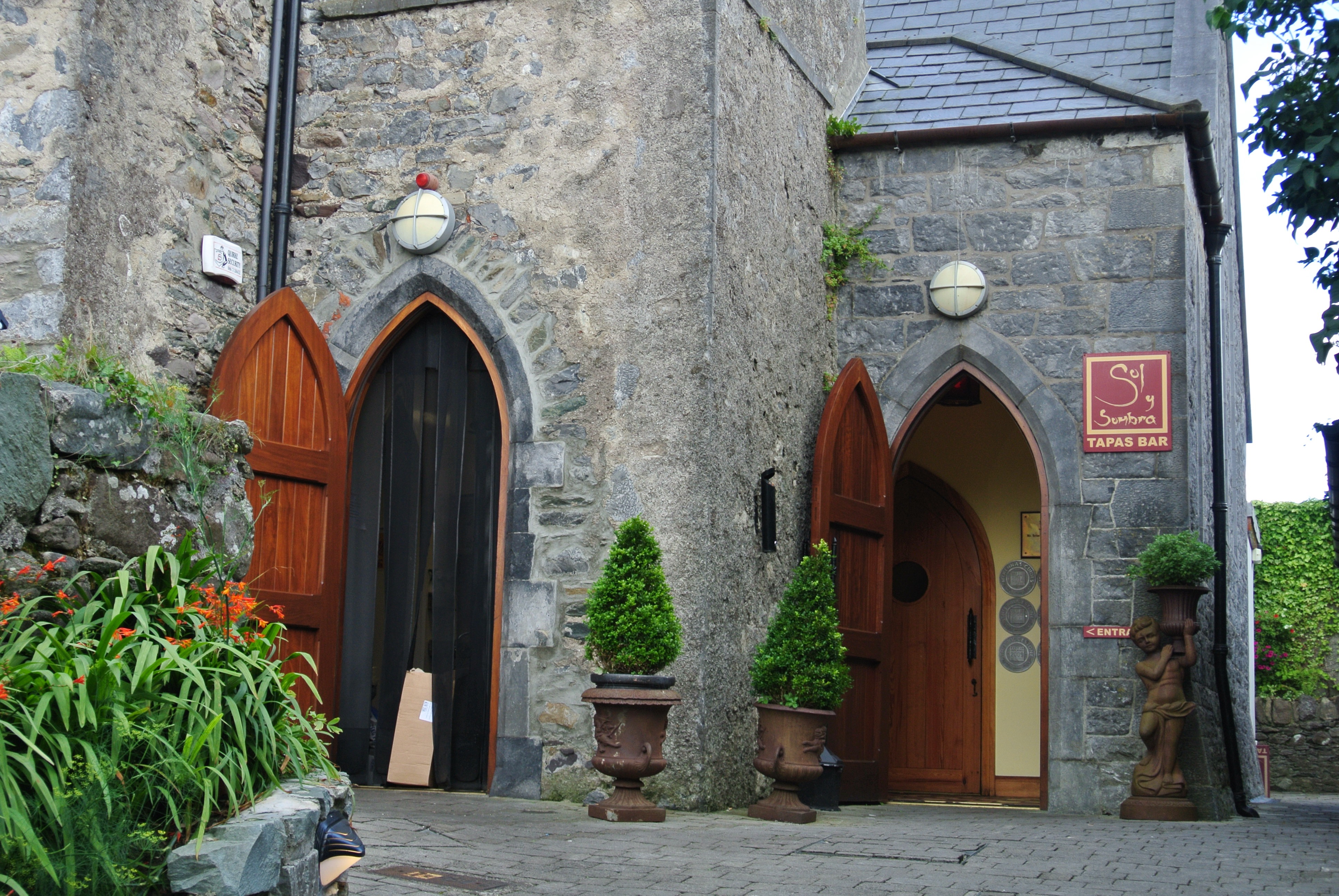
In 2011, two enthusiastic Kerry historians, Janet Murphy and Eileen Chamberlain, fascinated by the many closed or crumbling churches they had seen in the county, published an overview of COI churches in Kerry, entitled The Church of Ireland in Kerry in the 19th Century, with the aim of recording the history of these churches and of the people associated with them. There is an entry for the Killorglin church but no Hicksons are mentioned there. Robert and George Hickson of Dingle, on the other hand, receive a lot more attention.
Robert was the rector of Duagh COI for an astonishing 61 years from 1810 to 1871, when he died. Duagh is a small village lear Listowel (where Robert was briefly a curate), in north eastern Kerry. The church there dwindled and was eventually closed after Dis-establishment, which occurred the same year as Robert’s death. The actual building, which was built in the early 1800s, has long since disappeared, falling into disrepair and subsequently demolished. There is no real trace of the building where Robert laboured for so many years. He seems to have been generally liked. According to Murphy and Chamberlain:
During his early ministry at Duagh, Rev Hickson was patron of a school there (Twelfth Report of the Society for Promoting the Education of the Poor in Ireland, by Christopher Bentham, Dublin 1824, p107). A notice of thanks to Rev Hickson, signed by 170 people representing the heads of ‘the whole body of farmers and small landholders’ of Duagh for his ‘kindness and humanity’ and ‘charity and goodness during the last dear and severe summer when to our certain knowledge over 200 families in the parish alone would have actually starved were it not for [his] humane exertions in their favour and enabling them to procure seed potatoes’ was published in The Standard on 16 September 1835. ‘We hope and trust that whatever new acts of parliament may take place under the present or any future government of Ireland that our worthy and humane friend may never be removed from our parish or neighbourhood’.
p.88 The Church of Ireland in Kerry in the Nineteenth Century
His brother George was rector of the church at Dromod, on the Iveragh Peninsula, for fourteen years from 1828 to 1842, after which he moved to a church in County Monaghan, where he remained till he retired in 1872. The existing church at Dromod, which exists to this day, was built some 20 years after George Hickson left. It seems that the church that stood in Dromod during the years of George’s ministry was in ruins, and the Rev Hickson conducted services at the Dromod and Prior schoolhouses for the whole time he was there.
Both Robert and George appear to have married and had families, but what became of their children and grandchildren is not known to me. My Hickson family, on the other hand, successively emigrated at the same time as Robert and George were busy ministering to their respective flocks in Ireland. Between 1853 and 1863, five Hickson siblings, four girls and one boy, all left for Australia. Then in 1865 William, the oldest son, with his wife, three children, and their 65 year old widowed father, Richard, left for America. John, the youngest, was the last to leave, departing sometime between 1866 and 1868 for Australia. He was 17 at the time his beloved brother William and his father left for America, and why he did not go with them is something of a mystery.
Their father, Richard, died in America in 1870 and is buried in Providence, Rhode Island. John, who by the mid 1870s had built a prospering business in his adopted land, managed then to persuade William and Mary that Australia held more promise for immigrants than America, so seven years after old Richard died, William and Mary, now with seven children, returned to Ireland and re-migrated, this time to Australia. They had been in the USA for 12 years, since the end of the Civil War. But ultimately they ended up Irish Australians, though four of their children were born in America. William would live the last 22 years of his life in Sydney, dying in 1899 at the age of 66. John lived on to a very old age, dying in Manly, Sydney, just before the end of WW2 at the age of 97.
The spiritual legacy of the Killorglin Hicksons
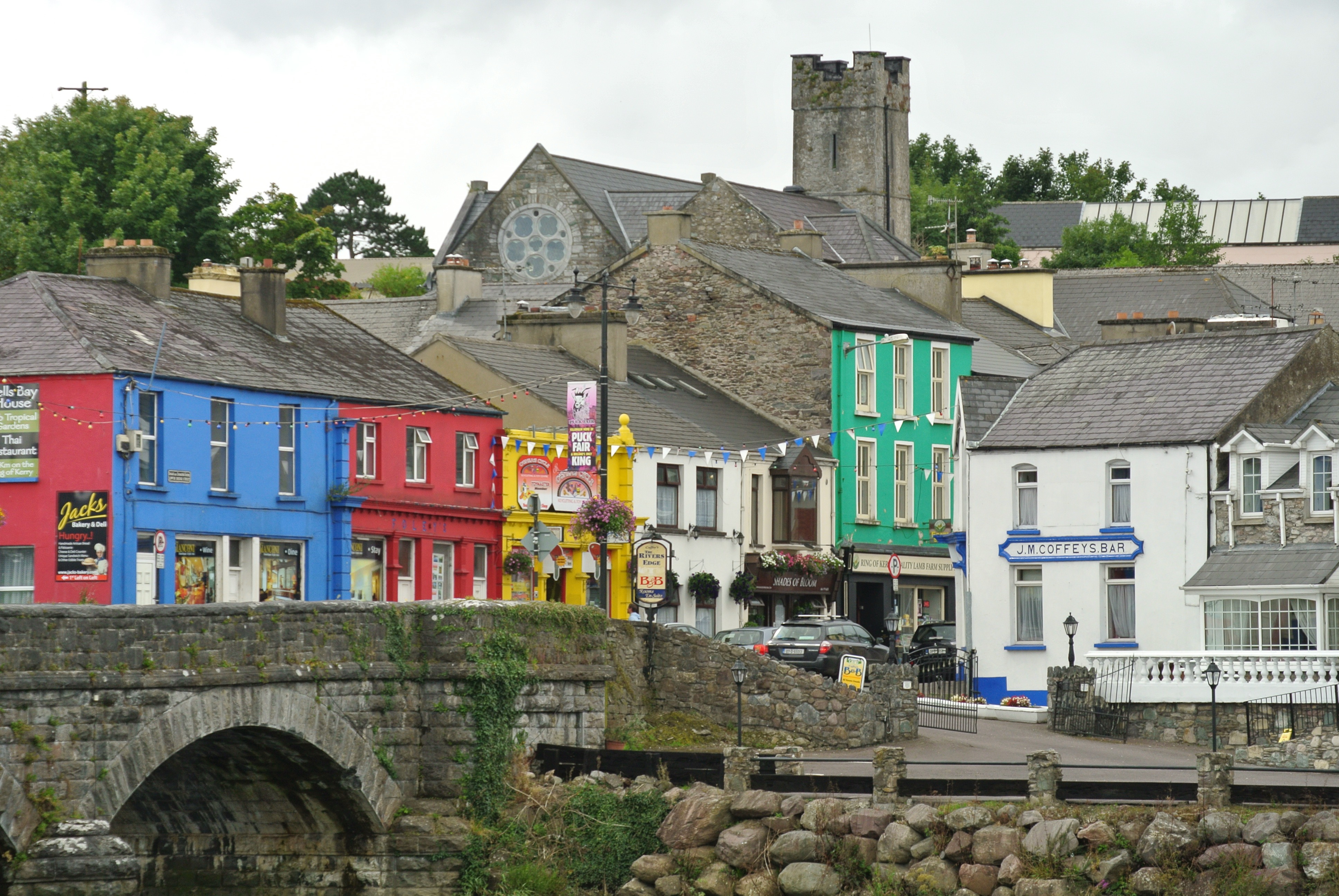
St James, the old church which Richard and Mary and their children attended, functioned for 188 years as the main Protestant place of worship in Killorglin. For at least fifty of those years my Hickson ancestors were associated with it. In one of the entrances to the old church there is a plaque commemorating Richard and Mary, placed there by John on a trip back to Kerry in 1911, more than forty years after he had migrated to Australia. John had done well in his adopted land, and was no doubt acutely aware that by 1911 most of the Hicksons, at least the Protestants, had disappeared from Kerry. He sensed the winds of change, and wanted to leave a mark in Killorglin, hence the plaque. He would not have imagined that the church would one day be closed and that the plaque he placed be forgotten, located as it is in a side entrance of a building which is used only by restaurant staff.
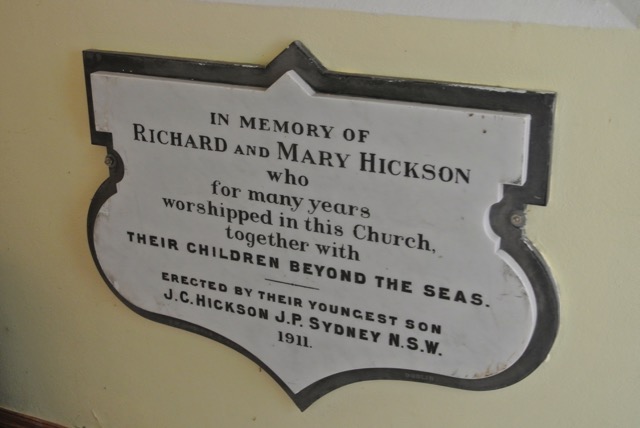
The Killorglin Church was associated at that time with the Blennerhassetts, a family of the Kerry gentry. William Blennerhasset Esq of Armagarry, Co Kerry, a contemporary of Richard Hickson, was something of a philanthropist; in 1836 he bequeathed £200 to the Foreign Bible Society, and £1000 in equal portions to establish a Protestant and Roman Catholic School in the parish. Although this perhaps speaks mainly of his personal piety, it suggests that in the Killorglin church there was a commitment to the promotion of both Bible knowledge in particular, and to literacy in general.
Education has been a focus of Christian mission since the very beginning. In Ireland, monasteries became the seat of learning as soon as Christianity took hold, from the pre-Catholic time of the Celtic saints, Patrick and Columba, Brendan and Brigid (to name a few of the better known ones). This continued to a certain extent after Roman Catholicism became the chief expression of Christianity in Ireland, although there was little commitment among the Catholics to making the Bible accessible to the common people. The Reformation changed all that, with Protestants keen to make the Scriptures available to ordinary people in their own language, something that the Roman Catholics, with their love of the mysticism of the Latin Bible, strongly resisted.
It was left to Protestants in Ireland to translate the Bible into Irish, with the first full translation appearing in 1685. The first Roman Catholic translation of the Bible did not appear until the early 1900s, translated from the original Greek and Hebrew by Peter O’Leary, a Roman Catholic priest and scholar. It is interesting that though for political reasons the British Government tried to to stamp out the Irish language, some of those most committed to preserving Irish, and to use of the Irish Bible, were in fact English speaking Irish Protestants. Blennerhasset may well have been one of these.
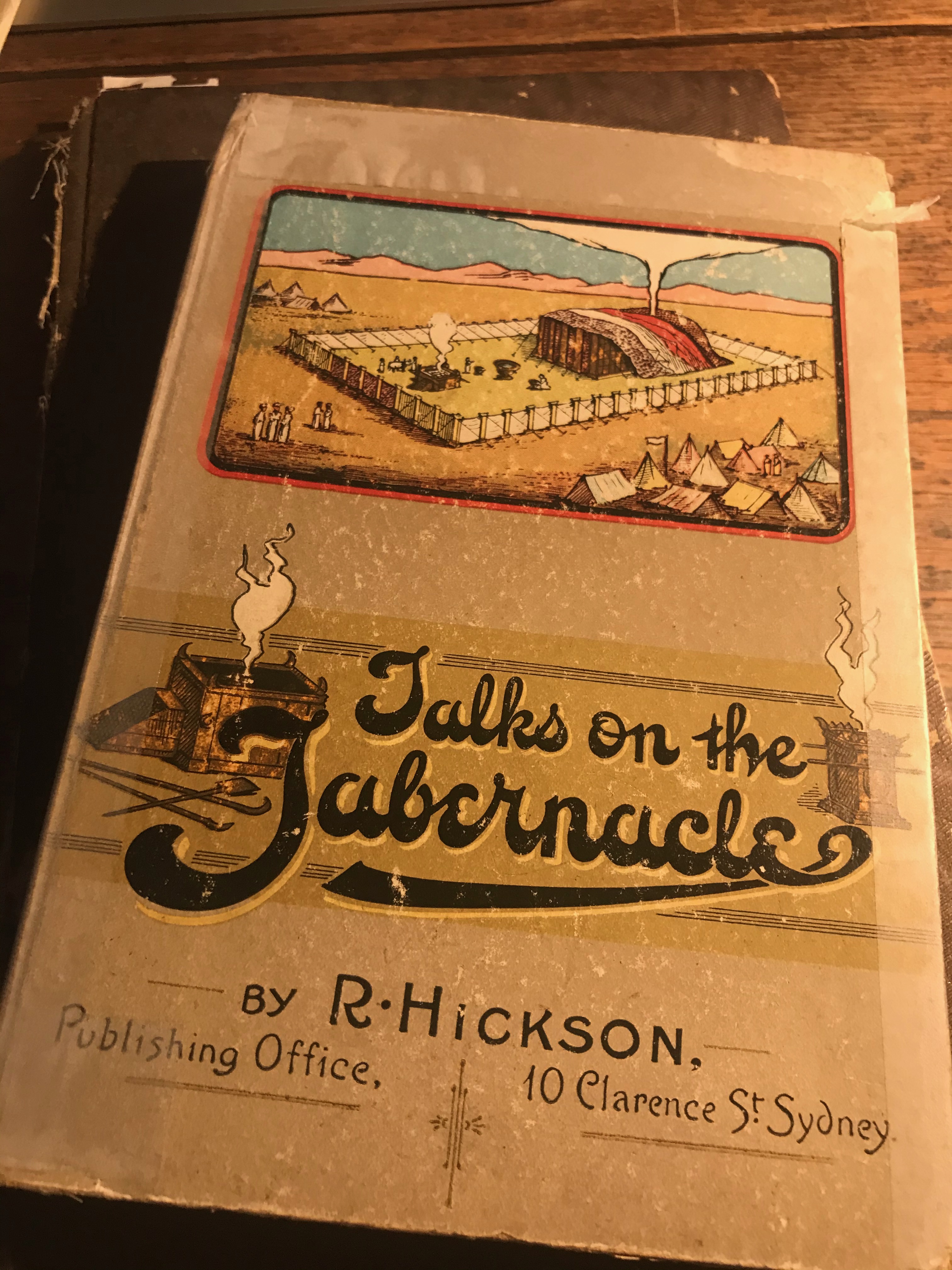
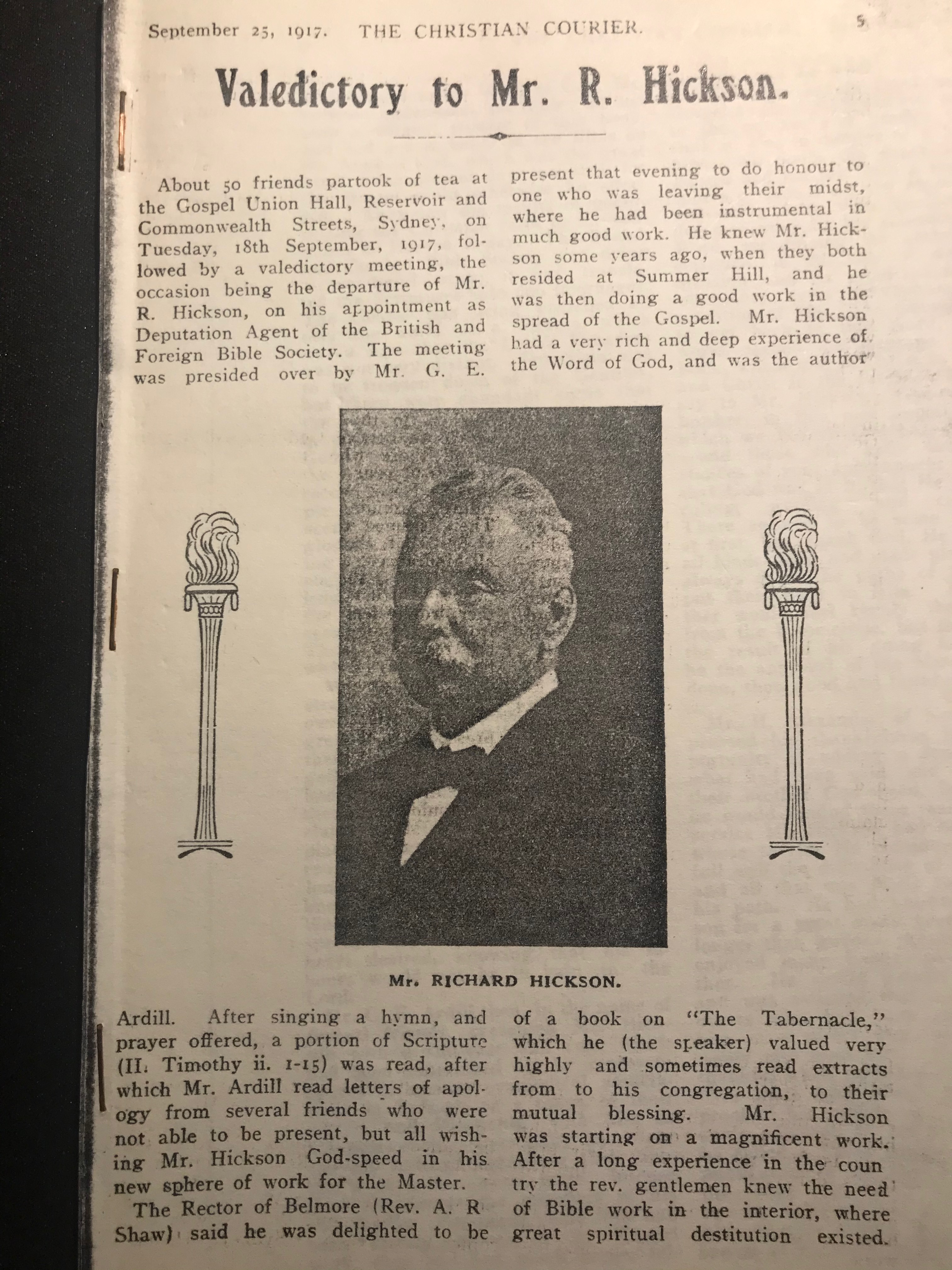
William Hickson and his wife took this commitment to the Bible with them to America when they emigrated, and it remained a central part of their family’s life when they relocated to Australia in the 1870s. This Bible legacy continued to be evident in later generations of William’s family in Australia. His son Richard, mentioned above, had a printing business in Sydney, and amongst other things published Bible tracts to be distributed on public transport in Sydney through the Tram and Ferry Mission. He also published a Christian periodical called The Christian Courier, and wrote at least one book, Talks on the Tabernacle. In his later years Richard became a deputation agent of the British and Foreign Bible Society (in Australia), devoting his time to the spread of Bible literacy. A great grandson of William, Keith Walmsley, was the accountant for the Bible Society in Australia for many years. This focus on the Bible and its place in faith and life was surely partly a legacy of the Killorglin Church.
John Hickson, who placed the plaque in Killorglin church in 1911, was also a committed Christian, and very involved in the Church of England in Australia. His first daughter, Alice, married William Ross, whose father had experienced Christian revivals in the Scottish Highlands in the 1840s and 50s. Alice and William had five daughters, one of whom married a clergyman, R.B. Robinson. Their son, Donald Robinson also went into the Anglican ministry and eventually became Archbishop of Sydney. Two of his sons, Martin and Peter, are also ministers. Don Robinson is renowned as one of the great “evangelical” archbishops of Sydney. The label “evangelical,” though it has become a term of derision for many with respect to the political leanings of American evangelicals, represents above all a commitment to the authority of the Bible. So in some small way, even Sydney Anglicanism has been influenced by the Church of Ireland in Kerry.
A connection between the Hicksons of Killorglin and Dingle
Mary Agnes Hickson, a distant relative and famous (if sometimes controversial) historian in Kerry during the nineteenth century, wrote a two volume work entitled Selections from Old Kerry Records, Historical and Genealogical 1872-1874 in which she traces some of the genealogy of the Hickson family under the heading “John Hickson of Fermoyle.” She mentions a certain “Stephen Hicson of Dingle de Cuisbe,” and explains,
This Stephen Hicson was probably the ancestor of the Hicksons of Dingle and Killorglin, many of whom remained Protestant, but I have been unable to trace the descents from his time to the last century (1700s) and can only here give what Sir Bernard Burke states of the former family… (Bernard Burke was one of the authors of Burke’s Landed Gentry, mentioned above).
What is clear from Mary Hickson’s account is that the ancestry of the Hicksons of Killorglin and Dingle was difficult to tease out, even for her, who lived much closer to their time. But it seems clear that the Hickson families in these two towns were related, common descendants of Stephen Hickson. John Hickson seems to have been aware of this, but he left no written record to explain what he knew of those relationships. It was important, however, for him to impress on his daughter the fact that their family was related to the Anglo-Irish gentry of Kerry. There is one line in his 1893 book, Notes of Travel, in which he mentions The Grove:
By rail we went to Dingle and visited The Grove, the old family seat of our ancestors…
I wonder how 21-year old Alice Hickson reacted to her visit to the ancestral seat, born as she was in the Antipodes?
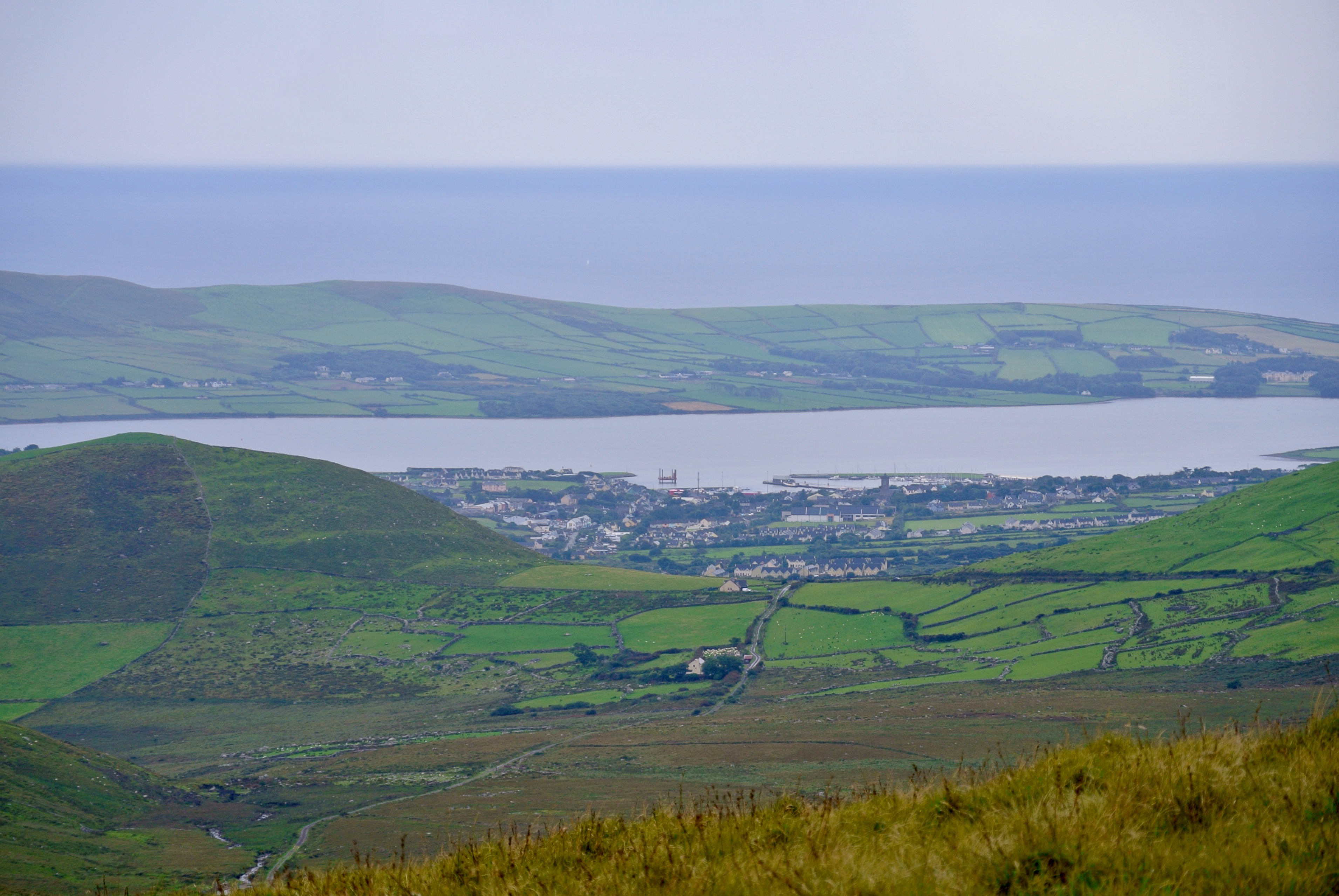
The Grove no longer exists, destroyed, presumably, in the Irish Civil War of 1919-23, when so many of the “big houses” of Ireland were burned. Old maps clearly show the demesne, but now there is a housing estate and a community school on the site. Near where the house once stood a road ascends the mountains up to the Conor Pass, the high point on the route northwards over the Dingle Peninsula.
Christian heritage
As already mentioned, various ancestors of both William Hickson and John Hickson continued a close involvement with the church. They have been usually more “evangelical” in their leanings, what might be called “low church.” However, perhaps the most famous minister bearing the name Hickson in Australia in the first half of the twentieth century was a certain James Moore Hickson, whose parents were also immigrants from Ireland. He became a high church Anglican minister in Australia. The reason for his fame was that he was gifted in supernatural healing, a gift that he discovered he had when he was still a child. He was well known in Australia as “Healer Hickson,” but became world renowned holding massive healing services in many countries. His story is told elsewhere.
The lives of my Hickson ancestors, descended from Richard and Mary Hickson of Killorglin, were directed by their Christian faith. Richard and Mary were members of St James Church of Ireland in Killorglin, which appears to have had a strong evangelical tradition, though the Church of Ireland is traditionally quite high church. Faith played an important part in the lives of the Dingle Hicksons too, who were somehow related to the Killorglin Hicksons. The brothers, Robert and George, who had grown up at The Grove, Dingle, both became COI ministers in Kerry and further afield. Their childhood home has long since disappeared, as have the churches where they served. Killorglin church remains standing but is no longer a church. The religious legacy of the Hicksons is carried on in their descendants, many of whom still profess the same faith two hundred years later.
 Forgotten tales
Interesting reading David, as always. I wonder if your Richard Hickson, who died 1880 was the namesake of Richard Byrne, born 1880? We know the connections between the two families so perhaps not a stretch too far.
Richard Hickson must have been named for his grandfather. But if his father William and George Byrne were as good friends as I believe they were, it would certainly not be surprising that George named one of his sons Richard after his old friend.
Just to clarify, Richard Hickson of Killorglin, lived from 1800 to 1870, or thereabouts. He is buried in America. William was his son. William’s first son was Richard, born in Kerry in 1859 and died in Australia in 1950 when he was 91 years old. His granddaughter lives in Newcastle quite close to us. Richard Byrne, as you know, was born in 1870, the year Richard Hickson senior died in the USA. He died in 1946 in Australia.
I am interested in having a greater understanding and connection to my family roots in Ireland. I have seen refgerences of the Hickson family and some of the names are quite familiar within my family. I have even seen two Maurice Hickson’s (deceased) in the records in Ireland. My wife and I are planning to visit Ireland and Scotland next year and it would be a great blessing to meet some Hicksons with whom we share a common ancestry. The following is what I have gleaned from some old family information. If there are errors, please forgive me.
What I have in my family records goes only as far back as Edward Hickson born around 1725 to 1730. Edward married Frances Wilson of Cashel. They had 2 children: William and Edward. I am a descendant of Edward (1771-1845). Edward was the Capt. Of Laun Ranger in 1794 and fought wars with Napolean in the Spanish Peninsula. Edward married Rose Spring and they had 7 children of which I am a descendant of Edward Spring Hickson (born around 1800). They lived in Milltown about 14 years then moved to Tralee. Edward was born in Dingle. And at 14 he ran away from home and became an apprentice to a druggist for about 7 years. He then returned to Ireland and joined his brothers in the lumber business. He emigrated to Canada around 1800 and acted as an agent for his brothers in the lumber business and shipbuilding. While in Canada he lived in Quebec, Seaforth, Kingston, Peterboro and Carleton Place. Edward Spring Hickson married Anne Lilliott and they had 7 children. I am a descendant of their son, John Hickson (1842-1912). John married Ann Beattie who emigrated from Scotland to Canada with her parents when she was 2 years old. They lived in Seaforth, Ontario, Canada and emigrated to Lynchburg, Virginia. John and Anne were my Great-Grand Parents. Their son, Maurice Beattie Hickson, Sr (1879-1961) was my grandfather, who also fought in the Spanish-American War. Their son Maurice Beattie Hickson, Jr (1907-1983) was my father. My Grandfather and my Father were both in the lumber business. My Grandfather had Hickson Lumber company in Lynchburg, Virginia and my Father owned Bedford Lumber Company in Bedford, Virginia. I am Maurice Beattie Hickson, III. I remember my Father saying that sawdust was in the blood of the Hickson family. In a way, he was right; I made my career in Ocean surveying and mapping but in retirement my wife and I are forest products producers growing mostly loblolly pines and some hardwoods for timber. Our daughters will inherit the tree farms and will carry on the tradition.
Thank you so very much for any help/information that you can provide.
Blessings,
Maurice B. Hickson, III
Hi Maurice, always good to hear from another Hickson (there are thousands around the world!). I was a bit confused by some of your message: first you mentioned that Edward Spring Hickson was born around 1800, making him a similar age to my ancestor Richard Hickson of Killorglin. But then you say he ran away from home at 14, became apprentice to a druggist for about 7 years then returned to Ireland. Where did he do his apprenticeship? England? So it would seem he returned to Ireland around 1821 when he joined his brothers in the lumber business. Then you say he migrated to Canada, but the date you have written for this was 1800 which is the date you recorded for his birth. Perhaps you mean 1830? His son John Hickson, born 1842, presumably in Seaforth, Canada, was your great grandfather. My John Hickson, of Sydney (born 1848 in Killorglin), was 6 years younger than your John Hickson. He was my father’s great grandfather. My dad is now 89.
Fascinating that you mention sawdust in the blood of the Hicksons. My John Hickson was a timber merchant in Sydney, and owned a mill on the mid north coast of NSW, in a town called Nabiac. I have written a bit about him in the following blog: https://holfiesfamilyhistory.blog/2022/09/04/great-lakes/. You may have already read that. I believe that John’s older brothers George (who died age 28 in 1874) and William (who had initially migrated to America) may have worked for John in Australia, though I have not found documentary evidence of that. The sawmill and wharf in Nabiac have long since disappeared. But John made his fortune in timber. I am not aware that any of his sons carried on the business. I am descended from his first daughter, Alice, who married an accountant and never left Sydney. Interestingly, I had thought of studying forestry when I was at school but ended up becoming a doctor. My wife is Swedish, and her family owned forest at one stage, though no longer.
Do you live in Virginia? You mentioned that you are planning a trip to Ireland and Scotland next year, presumably 2024. My wife and I are hoping to go there this year, in July August. So we will miss you. It would have been fun to connect in Ireland!
Thanks for making contact. I will have more a look through the stuff I have on Hicksons and see if I can work out our connection more accurately.
Kind regards
David
Hello:
I sent a message a few days ago about a lovely little sketchbook I have done in the 1830s and signed by a Mary Hickson of County Kerry in October of 1833. She has sketches of historic buildings, a barnyard scene and a young woman and little notes about the churchs and castles she drew. Her work is very good. I obtained in many years ago in a bookshop in Cork and would like to sell it. If interested please let me know so I can share my email address with anyone who is interested for further discussion. Thankyou. Lynn (I am in Canada)
Hi Lynn, thanks for getting in touch. Lucky you to have found that little sketchbook. I wonder which Mary Hickson was the artist? There were so many Hicksons in Kerry and Cork in the 1800s and Mary is about the most common girl’s name in Ireland. My Hickson ancestors were from Kerry, Killorglin, and were named Richard and Mary Hickson. They married in around 1829, so I suppose it is possible that the sketchbook you have is by her, even if you found it in Cork. In 1833 she already had two children, and her third, born in 1835, was named Mary too. Of course I would love to see the sketchbook, but I am not sure that I would buy it, since I’m not sure that it is from my family. It would of course depend on what the sketches depicted and what text there is to explain the locations.
Hi David , my name is Joseph Hickson, I’m from Boston , MA and have just started looking into my ancestry and was surprised to find out the Hickson name was so well known in Ireland during that time period. Robert Hickson of CO. Kerry is my 3rd Great Grandparent on my father’s Paternal side , he died in Bangor Maine in 1905. It’s really fascinating learning about all this because Hickson isn’t a very common name so to be able to find all this information and connect with distant relatives is really cool! I’d love to know any other cool facts you’ve dug up so far and I will let you know what I find as well! Well hope to hear from you soon thanks!
Hi Joseph, great to hear from a Hickson in Boston. As you may have realised from reading my blog, one family in my history lived in the Boston area for 12 years before moving back to Ireland and then migrating a second time to Australia. That was William Hickson, his wife Mary and his children. His oldest daughter Susie was my great grandmother. But since they left before any of their children were of marrying age, there are no descendants of that Hickson branch in the USA.
However, there are clearly other Hicksons in America – you are one. I would be interested to hear which branch you are from. You wrote of your great great grandfather as being Robert Hickson. Was he the Robert Hickson who lived at The Grove and became a clergyman in the COI? I wrote about him in the article. But I am aware that there was more than one Robert Hickson in Kerry, so perhaps he was not your ancestor.
Let me know how your exploration of your family line goes. One of these days I will get to Boston and then I will be able to see where my ancestors lived, even if only for 12 years. William Hickson’s wife was Mary Needham, and pretty much all of her family, who were also from Kerry, stayed in North America. So I am keen to see where they lived too.
Stay in touch!